Salesforce lists some Agentforce actions at $0.10. SAP assigns 0.02 AI units to certain agent actions. Workday prices a completed task at five times the rate of an information retrieval. Three models, one direction: the vendor defines the billable unit. That would be a pricing question only, if the same vendor did not also decide which routes an agent may take and supply the dashboard that judges whether the spend was worth it.
Forrester's Faram Medhora put it in one line on 3 November 2026: application vendors now control the meter, the gate and the referee. The meter is what counts as billable. The gate is what an agent may reach. The referee is the governance and monitoring tooling that tells you whether it worked.
Integration architects feel the gate first. Forrester points to SAP's April 2026 API policy, which restricts third-party agents that plan or execute sequences of SAP API calls outside approved paths. An external finance agent that needs an SAP transaction may have to go through a Joule-mediated route. SAP has a legitimate interest in protecting its application. But when the approved route is also metered, an API policy becomes an architecture constraint and a commercial lever at once.
Credits consumed and agents activated are activity. Work removed, cost avoided and quality improved are outcomes. Forrester made the same point in its review of H1 2026 enterprise software earnings: adoption and activity metrics say little about effort removed or cost avoided.
This matters because consumption pricing is becoming the renewal baseline. Growth Unhinged's 2025 State of B2B Monetization survey of more than 240 software and AI companies, summarized by Orb, found hybrid pricing up from 27% to 41% in a year and flat-fee subscriptions down from 29% to 22%. If you cannot rebuild the vendor's bill from your own event records, you negotiate the renewal on the vendor's numbers.
Lock-in moves the same way. "We can export our data" is not an exit plan when the switching cost sits in orchestration logic, configurations, permissions and agent behavior.
Forrester's six lenses translate directly into integration decisions:
- Know who acted: every production agent has its own identity, an owner and bounded authority.
- Keep the evidence: what the agent saw, which rules it applied, which tools it called and what it changed, stored outside the vendor's console.
- Verify the value: set consumption against completed transactions, exceptions, human corrections and financial impact.
- Know the real price: count retrievals, API calls, retries, approvals and reversals at production volume, not pilot volume.
- Choose the route: write the supported routes, mandatory gateways, charges and telemetry rights into the contract.
- Keep the off switch: test that you can revoke authority, stop execution, keep the evidence and find unfinished work.
All six are easiest to set while the agent is still optional.
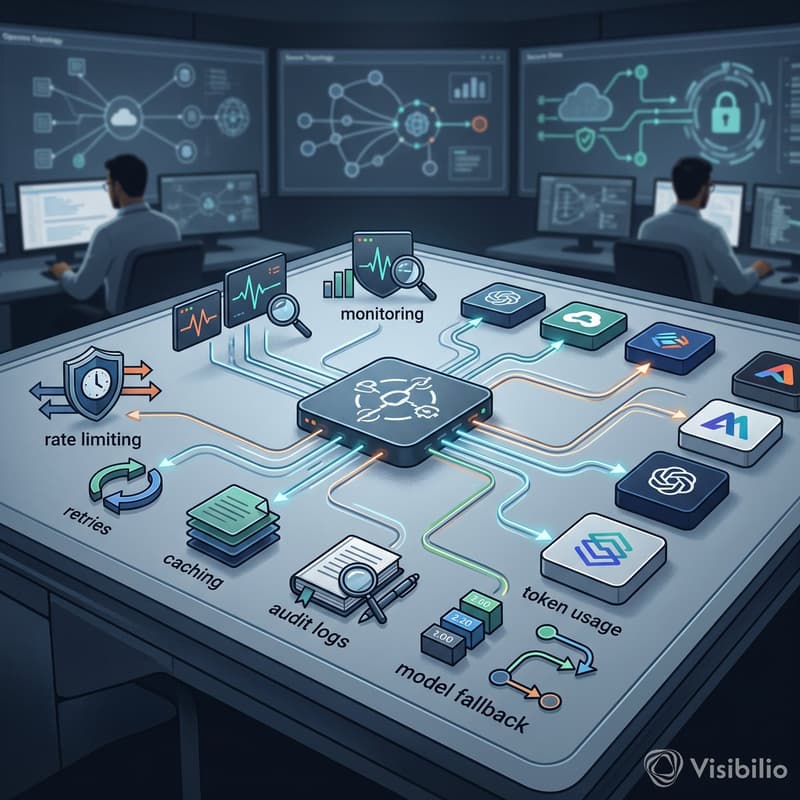
A vendor's governance tooling sees the vendor's suite. In the mixed estates we work in, SAP next to webMethods or Camunda, an agent's work crosses several systems, and no single vendor console sees all of it. The one place that does is the integration layer every call already passes through. That is where we put the referee:
- Your own gateway: route agent calls to core systems through it, so identity, policy and limits are yours, whichever vendor's agent is calling.
- Your own records: log every call as an event with agent, owner, route and outcome, so you can rebuild the vendor's bill and check it.
- Your own off switch: keep it at the gateway, where one decision stops agents from every vendor.
It is the same discipline as API governance with versioning, deprecation and policy as code, applied to a new kind of caller. Adopt agents for the value they deliver, but make sure the terms, the telemetry and the off switch belong to you before the agents become load-bearing. Designing that layer is the core of our Enterprise Integration & BPM work.