Technology partner since 2025
Visibilio.ai
We build Visibilio's AI-powered content and storytelling platform. The newest articles in our own Content Hub are published through it.

We build AI agents that retrieve, reason and act inside your processes: connected to your systems and governed like any production system.
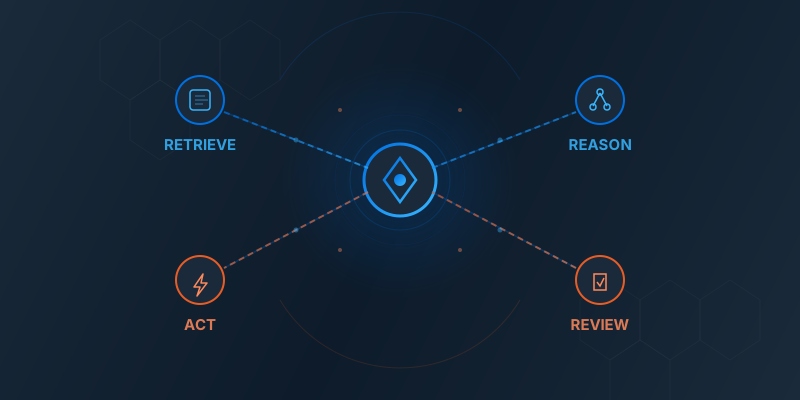
An agent is useful only when it can reach your systems, and safe only when you control what it does there. We build agents that act through your integration layer, with scoped permissions, audited tool access and a person at the checkpoints that matter.
We design and build agent architectures that solve real business problems: multi-agent workflows that coordinate like a well-run team, intelligence hubs that surface what matters, and content pipelines with human review.
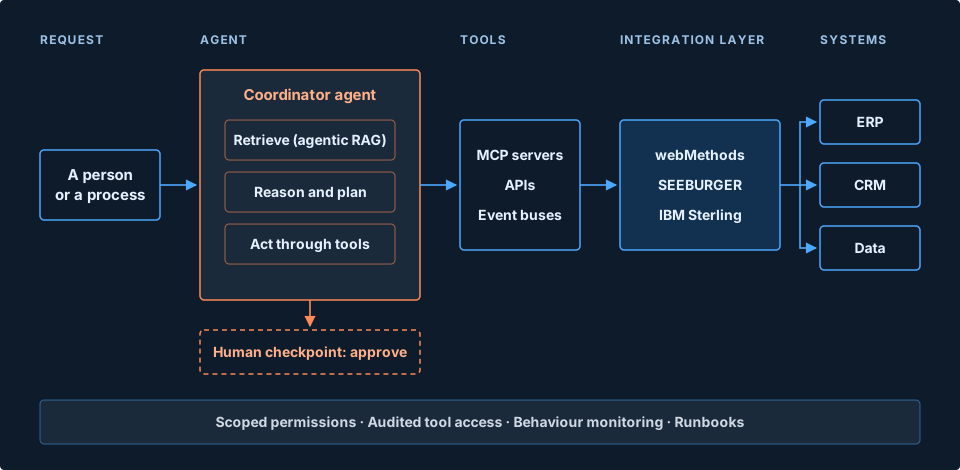
Specialist agents that collaborate under a coordinator: a researcher gathers data, a writer drafts, an analyst validates and a publisher releases. Built on LangGraph and CrewAI.
Retrieval that plans ahead. Our agentic RAG systems choose a retrieval strategy, route queries across knowledge bases, keep context across sessions and refine their answers, turning static document stores into living knowledge.
The Model Context Protocol (MCP) is the open standard for connecting agents to tools and data. We build MCP-native agents that reach your CRM, ERP and analytics through standardised, auditable interfaces instead of brittle point-to-point code.
Platforms that gather, process and present data for decision-makers. Agents work across internal metrics, market signals and competitive intelligence to deliver timely insights.
Agents that research, draft, review and publish content across channels. They work to your brand voice, audience and editorial workflow, with human approval where it matters most.
Technology partner since 2025
We build Visibilio's AI-powered content and storytelling platform. The newest articles in our own Content Hub are published through it.
Built for agents
kondevs.com runs a read-only MCP server with four tools and an A2A agent, protects its publishing API with OAuth and serves every page as markdown to AI agents. See the MCP server card.
| Use case | What the agents do | Outcome |
|---|---|---|
| Automated content pipelines | Multi-agent workflows research, draft, review, optimise and publish content | Faster editorial cycles with a consistent brand voice |
| Customer intelligence | Analyse interactions across channels, surface patterns and trigger personalised engagement | Conversation data turned into revenue signals |
| Strategic decision support | Aggregate market data, internal KPIs and external signals into dashboards and briefs | Briefs leadership teams can act on |
| Knowledge management | Agentic RAG makes institutional knowledge searchable, contextual and actionable | Intelligent assistants instead of static wikis |
Production-grade AI agent systems that plan, reason, retrieve and act. Deliverables include multi-agent systems, agentic RAG pipelines, MCP-connected agents, content creation agents and enterprise intelligence hubs.
Retrieval that plans ahead: the system chooses a retrieval strategy, routes queries across several knowledge bases, keeps context across sessions and refines its answers, turning static document stores into living knowledge.
Agents are designed for production from day one, with scoped permissions, audited tool access and behaviour monitoring. Systems include configurable human-in-the-loop checkpoints: review gates, approval flows and overrides.
LangGraph, CrewAI, the Model Context Protocol (MCP), agentic RAG, LLM orchestration, vector databases, Python and Node.js. Agent workflows connect to enterprise platforms through APIs, middleware and MCP servers.
Yes. Our integration roots let agents reach your systems through APIs, middleware, event buses and MCP servers, including SAP ERP and S/4HANA through webMethods and SEEBURGER.

In four days AI coding agents made 74 reviewed changes to kondevs.com on Cloudflare, under human approval. What that taught us about agentic readiness, AI-assisted development and governance.
A walkthrough of Advait Patel's zero trust architecture for AI agent systems, set against survey data that shows how far agent adoption has outrun agent governance: four failure modes, five layers, and three questions to answer about an agent you already run.
When one vendor prices, gates and grades your AI agents, you lose leverage. Six controls to set before production, and where the referee belongs.