A call times out at 02:14. The downstream service returned no response. The question every integration architect should ask next is not "did it fail?" but "did it succeed and I just don't know?" As the AWS Builders' Library puts it, a timeout doesn't prove the remote operation failed, because the remote system may well have finished the work while the response was lost in transit. That ambiguity is the root of most 2 a.m. integration incidents. Not the crash. The uncertainty.
Too many teams treat timeouts as binary: success or failure. Production doesn't work that way. A timeout creates a third state, "unknown outcome," and every downstream decision (retry? compensate? alert?) depends on how the architecture handles that ambiguity. If it only works in the happy path, it does not work.
This is why the topic deserves more than a passing mention in your architecture decision records. As AI-driven workflows enter enterprise integration layers, the number of outbound calls per business process is growing. More calls means more timeout surfaces. More timeout surfaces means more ambiguity at 2 a.m., unless the patterns underneath are explicit, tested, and owned. The four patterns that follow (timeouts, retries, idempotency, dead-letter queues) form a dependency chain. Skip one and the next one breaks.
Choosing the right timeout value matters more than most teams admit. Picking a round number ("let's say 5 seconds") is guesswork. The AWS Builders' Library recommends selecting based on percentile latency of the downstream service: for example, choosing the p99.9 downstream latency corresponds to accepting a 0.1% false-timeout rate. That's a design decision, not a default. And it has to fit within the caller's own deadline. Set explicit timeouts on every outbound call before you even think about retry logic.
Retries feel safe. A call failed, so try again. The logic is intuitive, and it works well for genuinely transient faults: a brief network hiccup, a momentary resource constraint. The danger is what happens when the failure isn't transient, or when hundreds of clients retry at the same time.
The pattern is straightforward and brutal: a dependency degrades, clients retry, the retry volume multiplies load on the already struggling service, and a partial degradation becomes a full outage. Unbounded or synchronized retries can amplify load and worsen an outage. The retry was supposed to be the safety net. Instead it became the accelerant.
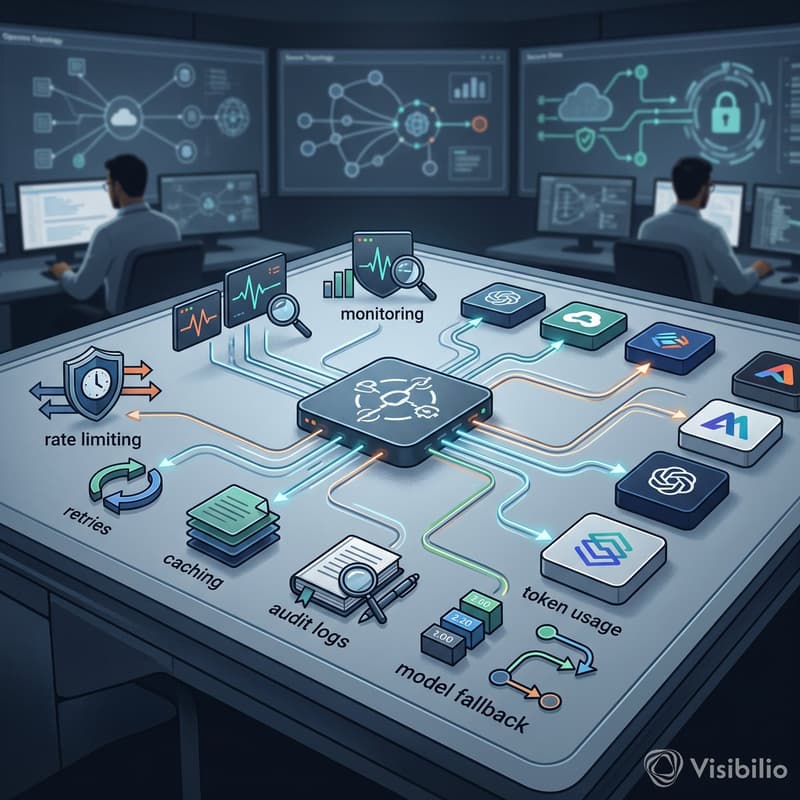
Three controls prevent this. First, bound retries: set a maximum attempt count and a total deadline. Second, exponential backoff: each retry waits longer than the last, reducing pressure on the recovering service. Third, jitter: randomize the wait so clients don't all retry at the same instant. Sounds obvious. In practice, teams bolt on retries first and discover the timeout gap during an incident.
One more thing worth saying plainly: for user-facing flows, fewer retries with faster failure and a fallback path may be better than "retry until it works." Aggressive retries improve eventual delivery rates, but they also increase tail latency. The user staring at a spinner doesn't care that the request eventually succeeded on attempt four if it took 40 seconds.
Retries become dangerous the moment the operation has side effects. A GET request retried three times is annoying. A payment request retried three times is a lawsuit. The bridge between "retry for resilience" and "retry without damage" is idempotency: the guarantee that executing the same operation multiple times produces the same result as executing it once.
The mechanism is a stable request identifier (an idempotency key) that the server uses to deduplicate. Stripe has used idempotency keys for years. The pattern is well understood. What's less understood is the cost: idempotency requires durable storage for keys, retention policies, and race-safe deduplication logic. It isn't free. For read-only operations, simpler retry policies may be sufficient. For anything that creates, modifies, or charges, idempotency isn't optional.
This matters even more as AI-driven workflows enter the integration layer. WSO2 published guidance on designing idempotent tools specifically for agent-based architectures, because LLM-driven workflows can re-issue actions when a step appears to have failed. An AI agent that retries a non-idempotent tool call doesn't know it just doubled the side effect. The integration layer stops being plumbing and becomes the control surface. Show me the rollback before you show me the demo.
After timeouts, retries, and idempotency, some messages still fail. A malformed payload. A business rule violation no retry will fix. A dependency that's been down for hours. Dead-letter queues isolate these messages so they don't block the main flow, don't get retried infinitely, and don't vanish silently.
The pattern is straightforward. The operational reality is harder. A DLQ without an alert is just a place where failures go to be forgotten. A DLQ without an owner is a backlog that grows until someone notices it during an audit (or an incident, whichever comes first).
The minimum viable DLQ setup includes four things: monitoring that alerts when messages arrive, clear ownership for triage, a retention policy so the queue doesn't grow unbounded, and a tested redrive mechanism that can replay messages safely. That last point circles back to idempotency: if the replayed messages aren't safe to re-execute, the redrive creates new problems instead of solving old ones.
These four patterns form a dependency chain, not a menu. Timeouts first, because without them you can't bound retries. Retries second, because without timeout clarity you don't know what you're retrying or for how long. Idempotency third, because retries on side-effecting operations without deduplication create duplicates. DLQs fourth, because they catch what the first three patterns couldn't resolve.
Skip a step and the next one breaks. Retry without timeouts and you extend tail latency while hiding dependency degradation. Retry without idempotency and you create duplicate charges. Use DLQs without monitoring and you've built a failure graveyard. Integration-specific SLOs (first-attempt success rate, eventual success rate, DLQ age) are better indicators than a single uptime number, because retries can mask a degraded experience if you only measure eventual delivery.
Architecture is the discipline of deciding where failure is allowed to happen. These four patterns don't eliminate failure. They contain it, make it visible, and keep it from waking anyone up at 02:14.