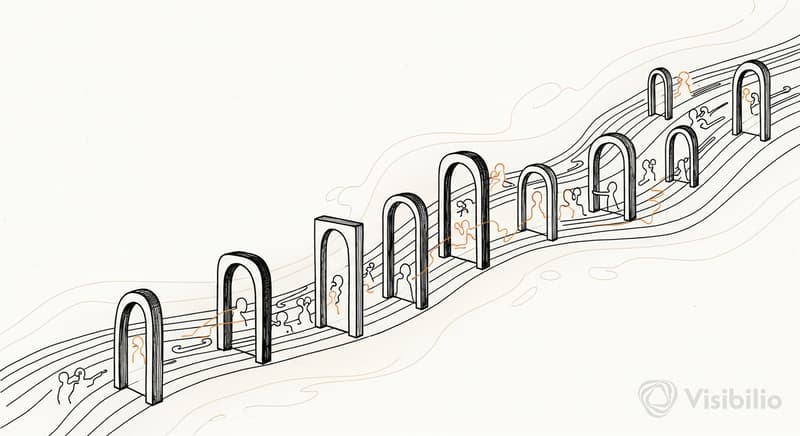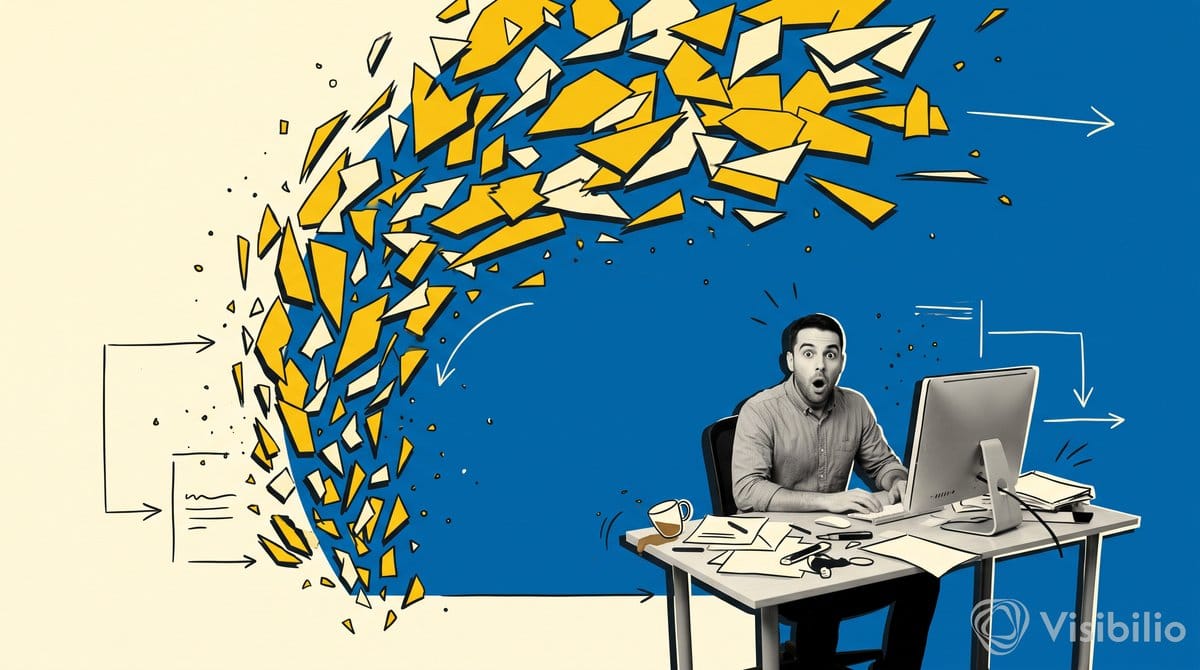
One process instance fails. It retries. The retry fails. Three more instances hit the same broken dependency and start retrying too. Within minutes, the queue is growing faster than anyone can read the alerts, and the on-call engineer is staring at hundreds of error notifications that all look the same. That's an exception storm: not a single failure, but a cascade where the orchestration layer's own retry logic amplifies the damage instead of containing it.
The term doesn't appear in a formal BPM standard. It describes something more practical and more painful: an operational burst of workflow exceptions, often from a shared dependency or bad input, that overwhelms retries, queues, and human handlers simultaneously. And the reason it matters right now is that as enterprises push more AI-augmented and agentic workflows into production, the surface area for these cascades is growing faster than the controls designed to stop them.
Before you can contain exception storms, you need to count exceptions correctly. Most teams do not. The common mistake is tracking raw error events instead of unique process instances. One stuck instance generating 200 retries looks like 200 problems in a dashboard. It's one problem, amplified by bad retry logic. That distinction changes everything about how you alert, how you staff, and how you invest in fixes.
A defensible approach starts with exception incidence: instances with at least one exception divided by total instances. Then layer on retry recovery rate, resolution time by exception type, and repeat-failure rate. For storm detection specifically, the indicators that matter are arrival rate, queue growth, retry volume, and blast radius across dependent workflows. Alerting on individual errors creates noise. Alerting on rate changes and queue growth creates actionable signals.
One exception-management analysis published by AInformat presents an approximate 80/20 split between happy-path and exception cases, with data exceptions accounting for roughly 40 to 50 percent of the total. Those numbers lack enough primary-source detail to treat as general benchmarks, but the shape is instructive: exceptions aren't edge cases. They're a significant share of production reality, and the data-quality subset alone can generate storm conditions if retries aren't bounded.
This is where most exception-handling designs go wrong. They treat every failure identically: retry it, escalate it, or drop it into a catch-all queue. But a missing approval document and a downstream service timeout are fundamentally different problems requiring fundamentally different responses.
Business exceptions (missing information, exceeded approval limits, ambiguous data) need routing and human decisions. Technical failures (timeouts, authentication errors, unavailable services) need bounded retries with backoff and jitter, circuit breakers, and quarantine queues. Conflating them is how you get the worst of both worlds: pointless retries on cases that will never auto-resolve, and unnecessary human escalations for transient network blips that would clear in seconds.
The control-plane job is separation. Model business exceptions as alternate paths in the process definition, not as error handlers. Model transient technical failures with bounded retry policies, idempotency checks, and duplicate suppression. Model unexpected or unrecoverable failures as suspend-and-investigate states: the instance stops, an actionable incident gets created, and someone with context looks at it. Three categories, three handling strategies. Mixing them is how storms form.
Here's the part that gets under-designed most often. Teams add a "notify human" step and call it human-in-the-loop. It isn't. A Slack message or an email alert is a notification. A durable workflow state that persists across restarts, binds evidence to a proposed action, records the decision-maker's identity and authority, enforces a deadline, and re-checks preconditions before executing the approved action: that's HITL.
The difference matters operationally and legally. If the workflow doesn't persist while waiting for human input, a deployment or restart can lose the pending approval entirely, or worse, duplicate the action. If the approval isn't bound to a specific proposed action, the human is approving a concept, not a concrete step. If there's no deadline, stale approvals pile up and eventually execute against conditions that no longer hold. Temporal's tutorial on durable human-in-the-loop patterns shows the first half of this: the workflow keeps waiting for the human without losing state, and once the decision is made it is stored durably. The second half is a design rule of its own: if the underlying context changes while the human is deciding, the approval should be invalidated and the preconditions checked again.
Microsoft's Agent Framework documentation now includes explicit HITL constructs for agentic workflows. Elastic has published guidance on incident-response automation with human approval gates, emphasizing evidence binding, time limits, and auditability. The pattern is converging across platforms: HITL is a designed workflow state with structure, not an informal escalation with hope.
Alerts tell you a storm is happening. Architecture prevents one. The containment patterns are well understood but inconsistently applied: bounded retries with exponential backoff and jitter (so retries don't synchronize and hammer a recovering service), idempotency and duplicate suppression (so repeated attempts don't create duplicate business outcomes), concurrency limits and backpressure (so the orchestration layer stops accepting new work when it can't process existing work), circuit breakers for dependency isolation (so one failing service doesn't take down every workflow that touches it), and dead-letter or quarantine queues (so poison messages get isolated instead of blocking healthy traffic).
None of these are new ideas. What's new is the urgency. As AI-augmented workflows introduce more decision points, more external service calls, and more variable execution paths, the number of places where a storm can originate multiplies. An LLM call that times out intermittently, a model whose confidence scores drift, an approval routing rule that sends everything to the same overwhelmed queue: each is a storm seed.
The uncomfortable truth is that not all exception bursts are orchestration problems. Sometimes the root cause is upstream data quality. Sometimes it's a shared dependency that needs its own reliability work. Control-plane design contains the blast radius, but it doesn't fix the source. Teams that over-invest in exception handling without addressing the upstream cause end up with very sophisticated ways of managing failures that shouldn't be happening at all.
A control plane, in the networking sense, doesn't carry traffic. It decides where traffic goes. BPM earns that label when it stops being a workflow execution engine and starts being the layer that separates business decisions from technical recovery, routes exceptions to the right handler (human or automated) based on type and severity, enforces containment policies before cascades form, and preserves enough audit context that every decision, automated or human, can be reconstructed after the fact.
The practical checklist is shorter than the architecture discussion suggests. Separate business exceptions from technical failures in the process model. Bound every retry with backoff, jitter, and a maximum attempt count. Make human approvals durable, evidence-bound, deadline-enforced, and re-validated before execution. Alert on rates and queue growth, not individual errors. And measure by unique process instance, not by raw event count.
I keep coming back to a simple rule: before you celebrate intelligence, design control. If a model can route, it can misroute. If a retry can recover, it can also amplify. The demo is not the system. The system is what happens when the third dependency fails at 14:07 on a Tuesday and the queue is already deep. That's where the control plane either works or doesn't, and where the difference between a handled exception and a storm is just one missing branch in a flowchart.