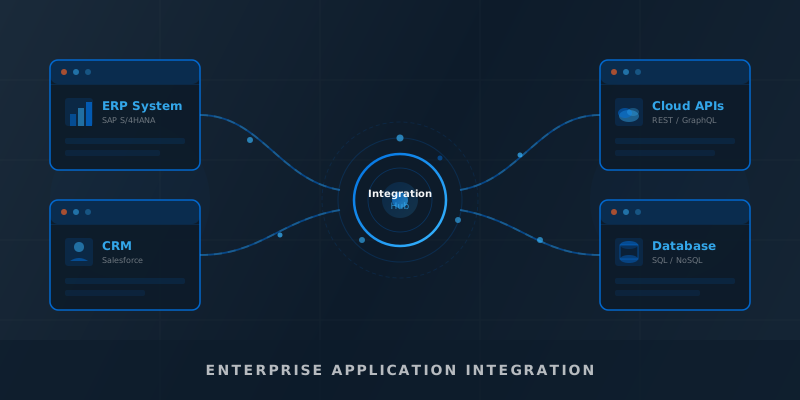
A customer changes their address. In a well-integrated enterprise, that single edit quietly updates the CRM, the billing system, the ERP, and the warehouse label printer: in seconds, with no one retyping anything. In a poorly integrated one, it triggers four tickets, two phone calls, and a misdelivered shipment three weeks later.
That gap is what Enterprise Application Integration (EAI) closes. EAI is the practice of connecting an organisation's separate software applications so they can share data, processes, and functionality as one coordinated system. The average enterprise runs on hundreds of distinct applications; EAI is the connective tissue that makes them behave like one.
The core problem: nobody designed this on purpose
#Almost no enterprise planned its IT landscape from scratch. Over years and acquisitions it accumulated systems: an ERP for finance, a CRM for sales, an SCM platform for logistics, an HR suite, an e-commerce engine, a dozen niche tools: each excellent at its job, none designed to talk to the others.
Left unconnected, those systems become silos. The same customer exists five times with five slightly different addresses. Month-end close waits on someone exporting a spreadsheet from one system and importing it into another. Leadership can't get a straight answer to "how many open orders do we have right now?" because the answer lives in four places. Integration is what turns that archipelago back into a single operating picture.
The four patterns that make EAI work
#Integration isn't one technique: it's a toolkit. Four patterns cover the vast majority of real-world cases:
Message-oriented middleware (MOM)
Applications talk by dropping messages onto a queue or topic rather than calling each other directly. The sender doesn't need to know who consumes the message, or when. This decoupling is what keeps one slow or offline system from taking the rest down with it.
Service-oriented architecture (SOA)
Each system exposes its capabilities as well-defined services behind a stable contract. Others consume them over standard protocols (SOAP, REST) without knowing (or caring) how the service works inside. Reusable, governable, and the reason an enterprise service bus exists.
Event-driven architecture (EDA)
Systems publish an event the moment something meaningful happens (order placed, payment cleared) and any interested system reacts. This is the pattern behind real-time responsiveness and elastic scale, typically carried by a broker like Apache Kafka.
API-led connectivity
The modern default is layered, reusable APIs: system APIs unlock data, process APIs orchestrate logic, experience APIs tailor it per channel. Each layer is independently governed, so new products assemble from existing building blocks instead of yet another point-to-point connection.
In practice, most serious landscapes use all four. Over 15 years across European finance, rail, insurance, and health-insurance IT (Deutsche Bank, ÖBB, and middleware connecting 80+ statutory health funds among them) we've yet to see a real enterprise that fits neatly into just one.
Why EAI matters more in 2026, not less
#It would be reasonable to assume the cloud made integration easier. It did the opposite. Enterprises now integrate across on-premise, private cloud, and several public clouds at once. Every new SaaS subscription adds integration points. And the appetite for real-time data (for analytics, and increasingly for AI agents that initiate actions on their own) means integration has to be faster, cleaner, and more governed than ever.
That last shift is the one to watch. An AI agent is only as safe and useful as the APIs it can reach. If your integration layer is brittle, undocumented, or inconsistent, AI doesn't fix that: it amplifies it, at machine speed. The enterprises adopting AI smoothly are, almost without exception, the ones that did the integration groundwork first.
Where to start
#If you're sizing up your own integration landscape, three questions cut to the core:
- How many systems need to share data today, and in two years? The trajectory matters more than the snapshot.
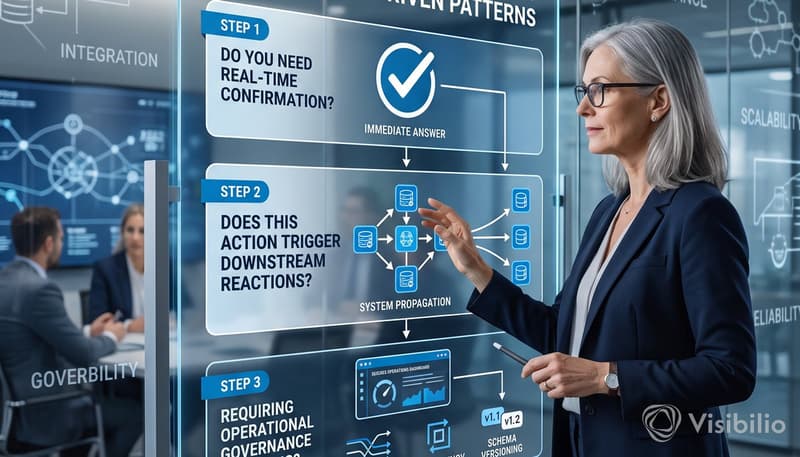
- What are your real-time requirements? Can a nightly batch suffice, or do you need event-driven flows that react in seconds?
- Do you have the in-house expertise to run an integration platform, or do you need a partner who has done it before?
At KONDEVS we've spent over a decade answering exactly these questions with enterprises, and building integration that scales with the business instead of fighting it. If that's the gap you're facing, let's talk.