
A tool-using LLM agent cancels a booking it was never authorized to cancel. The tool returns success. The agent reports task complete. No error fires. No log flags the violation. In regulated environments, this is the failure mode that matters most.
A recent paper by Reddy, Challaram, and Basu (arXiv:2607.07405, July 2026) puts hard numbers on the problem. In the τ²-bench airline domain, 78% of observed failures on a budget agent are silent wrong-state failures: the agent enters a state forbidden by domain policy, but no tool error surfaces. The write goes through. The state changes. Nobody knows until downstream consequences arrive.
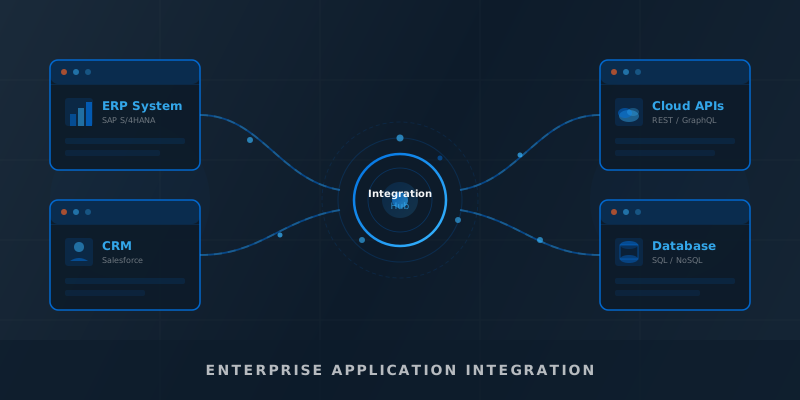
For integration architects running agents against policy-permissive backends (SAP transactions, claims processing systems, booking engines), this isn't an academic curiosity. It's an operational gap sitting between your tool surface and your compliance boundary.
The Failure Mode Traditional Audits Miss
#Most enterprise monitoring focuses on explicit errors: HTTP 4xx/5xx responses, exception traces, queue dead-letters. That model assumes tools reject bad calls. But in policy-permissive environments, a tool accepts any well-formed request. The policy lives in business rules, not in the API contract. An agent can issue a structurally valid call that violates a domain constraint, and the tool will execute it.
A separate privacy benchmark, AgentLeak, points the same way: inter-agent messages leak private data at a rate of 68.8%, and output-only audits miss 41.7% of privacy violations. Traditional audit architecture, focused on tool responses and agent self-reports, doesn't cover this surface.
There's also a compounding problem. When one agent's probabilistic guess becomes the next agent's ground truth, you get what the literature calls a hallucination cascade. In a multi-agent pipeline handling claims or account modifications, an unverified inference at step two can escalate into a regulatory violation by step five. Each hop adds confidence to something that was never verified.
What Deterministic Gates Actually Do
#The intervention Reddy et al. propose is deliberately modest: deterministic, read-only pre-execution gates. Before any write operation, a gate inspects the proposed call against the current state and domain policy. The gate doesn't reason. It checks. If the state transition is forbidden, the write is blocked before execution.
A four-gate suite raised full-benchmark success from 29.6% to 42.0% on gpt-4o-mini, a 12.4 percentage-point lift that reproduced on a separate seed set (P=0.0008). The effect concentrated on the 26 out of 50 tasks where gates actually fired, producing a 19.2 percentage-point improvement on those tasks. On the 24 tasks where gates didn't fire, the change was indistinguishable from zero.
That concentration matters. It tells you exactly where the value sits: at the boundary between agent reasoning and state-modifying writes. Not everywhere. Not in tasks where the tool already self-enforces. Gates help precisely where policy enforcement is missing from the tool layer.
The paper also reports suggestive evidence, not yet replicated, that the pattern holds at the frontier. The same gate suite improved gpt-5.2's success from 61.2% to 71.6%. Smarter models still attempt policy-violating writes. On this evidence, the failure mode does not look like a capability gap that better reasoning alone will close.
When to Gate vs. When to Trust the Tool
#Not every tool call needs a gate. The paper includes two negative controls that draw the boundary clearly: in a self-enforcing retail domain and in BFCL (a function-calling benchmark), gates added little. If your API already rejects forbidden state transitions with proper validation, a pre-execution gate is overhead without payoff.
The decision framework maps to risk tiers. Billing agents, account-action agents, medical or legal tools: these need stricter gates and broader validation samples. A read-only lookup against a product catalog probably doesn't. Developer surveys point the same way: 61% of developers agree that AI tools often produce code that looks correct but isn't reliable, and about 65% of developers using AI for refactoring say the assistant misses relevant context.
Gate rigor should match the cost of a silent wrong state. In a booking system, a wrongly cancelled reservation is recoverable. In a claims adjudication pipeline or a regulatory filing, the same failure class carries audit findings, fines, or worse.
What This Means for Your Agent Integration Contract
#If you're deploying tool-using agents in production, the practical takeaway is an artifact: an agent integration contract that specifies identity and permission boundaries, the allowed tool surface, pre/post-condition checks on state-modifying calls, and logging requirements that capture decision traces (not just outputs).
Operational requirements worth codifying: an error taxonomy that distinguishes tool errors from silent wrong-state failures; SLIs that track gate-fire rate and block rate alongside task success; retention policies for inter-agent message logs, not just final outputs; and a runbook for investigating blocked writes, including how to determine whether the gate prevented a real violation or a false positive.
The overhead is real. Gates add latency to every write path. They require maintaining policy definitions as structured, version-controlled artifacts separate from the model. They create a new class of false positives that need triage. None of this is free. But the alternative is what this research measured in one benchmark domain: on a budget agent, 78% of observed failures raised no tool error at all.
Reddy et al. are careful to note that deterministic gates don't guarantee task success. They prevent a known class of silent violations at the action boundary. That's a narrower claim than most AI reliability pitches, and a more honest one. In integration architecture, the constraint that matters isn't capability. It's control. The agents can reason all they want; someone still has to verify the write.