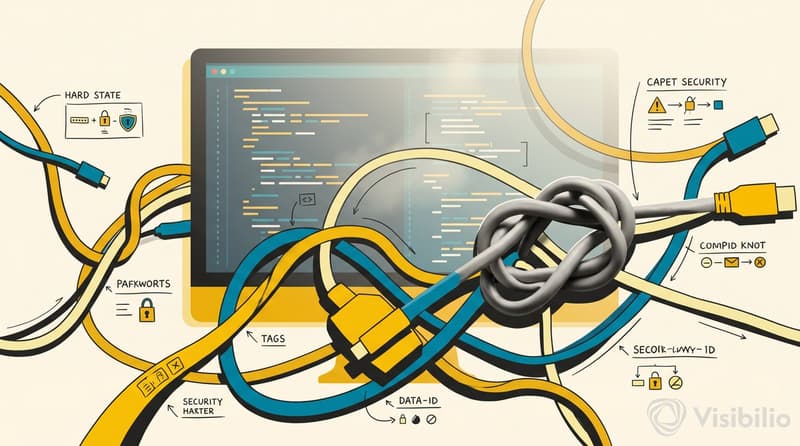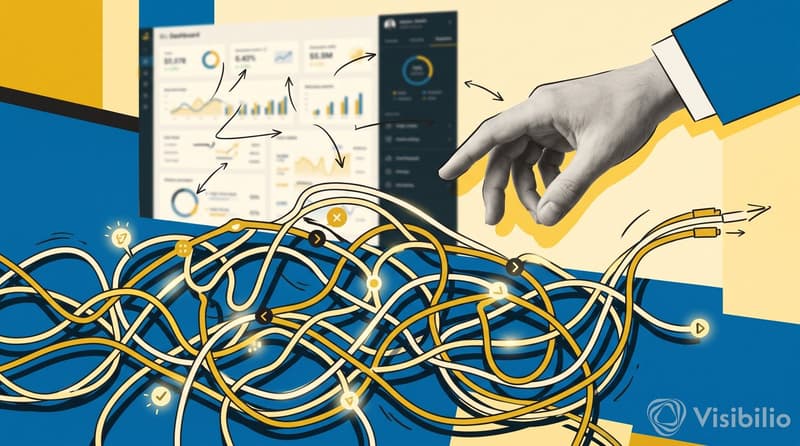

Fifty-five percent of IT decision-makers in the U.S. and U.K. already use or test agents that can change systems, permissions, records, or workflows, according to JumpCloud's Q4 Pulse Report, a survey of 250 IT decision-makers. That number should make any integration architect pause. Because when an agent calls an API to update a customer record, approve a payment, or modify a workflow, the thing standing between intent and consequence is the integration layer. Not the model. Not the prompt. The integration layer.
And 72% of those same leaders report a moderate-to-large gap between what their AI may access and what they can prove it accessed.
That gap is not a policy problem. It is an architecture problem. The integration layer either enforces routing, permissions, and accountability at runtime, or it doesn't. Written governance policies sitting in a SharePoint folder do not stop an agent from calling a downstream API with overly broad credentials at 02:13 on quarter close.
Enterprise architects have spent years building integration layers to mediate between applications, data sources, and business processes. Routing logic, transformation rules, error handling, retry policies: these are governance mechanisms, even if nobody called them that. The layer decides which system receives a request, under what conditions, with what identity, and what happens when things fail.
What has changed is that the actors are no longer only human users and scheduled batch jobs. Agents now sit in the same execution path. An agent's tool call becomes an API call into an ERP, a CRM, a payments engine. The integration layer is where that call either gets checked, logged, and authorized, or where it slips through with ambient credentials nobody reviewed.
This is familiar ground for us at KONDEVS. Since 2015 we have built and delivered webMethods integration and BPM landscapes in financial services, railways, insurance, and logistics, and the questions an agent raises are the ones every integration already answers: which identity calls, which route it takes, who approves, and what is recorded. We have written about the pieces before: an AI gateway as the enterprise control plane, trace IDs that follow a request through APIs, queues, BPM, and AI calls, and why default-deny egress beats trusting the model's own account.
UiPath, which sells orchestration software, put this bluntly: the AI governance gap is an architecture problem, not a policy documentation exercise, and governance has to be part of the orchestration architecture itself. If you already own the integration layer, you already own the place where those controls belong.
The term "control plane" gets thrown around loosely. Here is what it means in practice, stripped of vendor decoration.
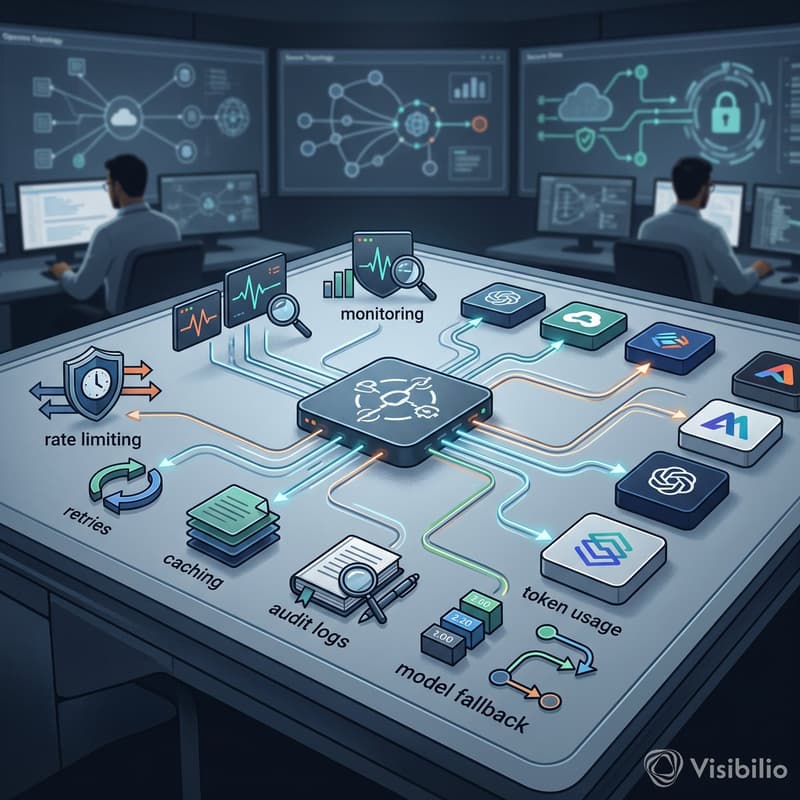
A practical control-plane design separates two concerns. First, a management plane: approved models, agents, tools, their owners, version history, policies, and change records. This is where you decide what is allowed. Second, runtime enforcement: evaluate each request or action, route it to an approved model or tool, apply identity and data policies, require approval for sensitive actions, and record the decision. This is where decisions become real. Collibra, a data governance vendor, describes this as the architecture that turns written governance policy into runtime controls across models, agents, and data sources.
The separation matters because it lets you change policy without redeploying code, and it lets you audit what happened without trusting the agent's own account of events.
Most enterprises already have fragments of this. API gateways enforce rate limits and authentication. BPM engines route approvals. ESBs apply transformation and routing rules. The question is whether these fragments are connected into a coherent control surface for AI actors, or whether agents bypass them entirely through direct API keys and shadow integrations.
Here is where it gets uncomfortable. JumpCloud's data shows that only 41% of organizations using agents fully integrate them into the same IAM policies used for human users. Forty-nine percent described AI permissions as broad, hard to review, or inconsistent. Only 14% review AI permissions continuously or automatically.
A NIST blog post from August 2026 argues that agents need to be treated as first-class entities with their own unique identifiers, and that their authorizations should be tightly scoped to business value and risk tolerance. It is a blog, not formal guidance; NIST's NCCoE says it will determine where further guidance is needed. The principle is still straightforward: do not treat an agent as a person with broad standing access. Use attributable identities, least-privilege permissions, scoped credentials, and explicit approval gates for high-impact actions.
This is not theoretical caution. When an agent has the same service account credentials as a batch integration built in 2019, and that account has write access to production financial data, you have a privilege sprawl problem that no amount of prompt engineering will fix. The integration layer is the place to enforce scoped, short-lived credentials per agent, per action, per context.
Every platform vendor will tell you they have logging. That is not the same as auditability.
Useful evidence links a specific request to a specific identity, the policy decision that was applied (including which version of the policy), the model or agent involved, the tool call made, the result returned, and any human approval that occurred along the way. All of this needs to be recorded independently of the agent's own narrative. An agent that logs "I completed the task successfully" is not evidence. A trace that shows request, identity, policy version, API call, response, and outcome is.
Deloitte's survey of 3,235 business and IT leaders across 24 countries found that only 21% said their organization had a mature governance model for agentic AI. That leaves roughly four out of five organizations operating agents without the kind of traceable execution records that a compliance review, an incident investigation, or a regulator would expect.
Regulation points the same way. Under the EU AI Act, record-keeping and logging duties attach to high-risk AI systems, and whether an agent workflow counts as high-risk depends on what it is used for. Whatever the classification, the evidence an auditor or incident review will ask for is the same trace described above, and it is far cheaper to design in than to reconstruct.
A centralized control plane is not a guarantee. It creates a false sense of security if agents can bypass it through direct API keys, shadow SaaS automations, or unmanaged integrations that nobody mapped. Coverage must be validated against real execution paths, not architecture diagrams.
Routing to an "approved model" does not equal authorization to access specific data or perform specific actions. Application-level authorization and data controls still must exist in downstream systems. The control plane mediates; it does not replace application security.
And logging alone does not create accountability if the logs omit downstream effects, use shared or ambiguous identities, or record only success states. The hardest part is not building the control plane. The hardest part is ensuring nothing routes around it.
Strip away the architecture terminology and what remains is a question any CIO or IT director will face during the next incident review or audit: can we prove what happened, who authorized it, and how we recover?
If the integration layer is where agents touch real systems, then routing, permissions, and accountability are not extras bolted onto a finished design. They are the design. The gap between what AI may access and what organizations can prove it accessed will not close with better policies. It closes when the integration layer enforces, records, and governs every action an agent takes, the same way it already should for every API call and workflow in the estate. The architecture question is simple: who owns the failure mode?
If you want to map where agents already touch your integration layer and which of those paths are governed, talk to us.