Cross-domain workflows rarely fail because teams lack opinions. They fail because architecture decisions get made on preference instead of criteria.
That is especially true when the conversation turns into API versus event-driven architecture. One team wants the clarity of a synchronous request-response model. Another wants the scalability and decoupling of events. Both are often right, and that is exactly why the debate drags on.
For BPM owners, this is not a theoretical issue. It affects how reliably work moves across domains, how visible process outcomes remain, and how much operational friction gets introduced for employees and customers. The real question is not which pattern is better in the abstract. It is how to choose the right pattern for the job.
A simple boundary test can help.
Most integration arguments stall on preference, not criteria.
APIs are familiar. They feel governed, direct, and easy to reason about. Events promise flexibility, fan-out, and looser coupling. In practice, cross-domain workflows often need both, but teams still try to force a single answer because it seems cleaner from an architecture perspective.
The problem is that workflows are not clean in the abstract. They involve:
- immediate business decisions
- multiple downstream reactions
- operational constraints
- ownership across domains
- different expectations for visibility and recovery
That means the better decision framework is situational, not ideological.
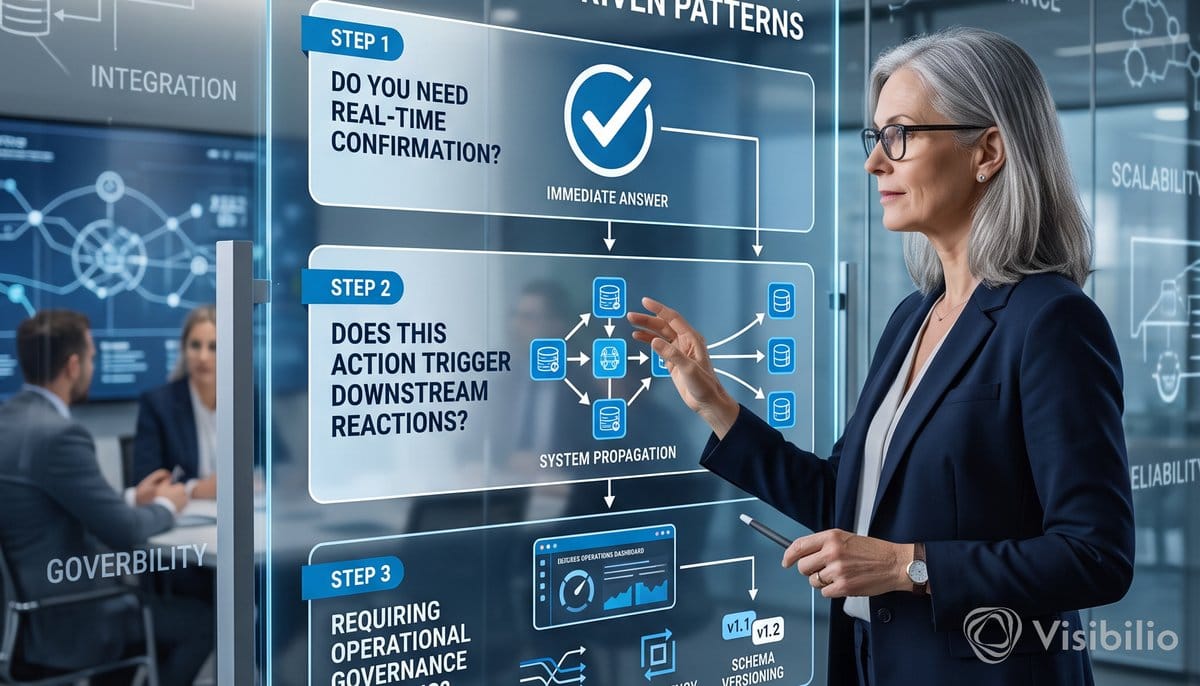
If you want to cut through the debate, start with these three questions.
1. Does the consumer need a confirmed answer right now?
This is the clearest decision point.
- Yes → API
- No → event
If a consumer must know immediately whether an action succeeded, an API is usually the right fit. It gives you a direct response and a governed interaction contract. That matters in workflows where the next step cannot proceed without confirmation.
Examples include:
- checking whether a customer record can be updated
- submitting an approval command that must return a result
- validating whether a task can be assigned before work continues
In these cases, the workflow depends on an immediate answer. An event would add uncertainty where the process needs confirmation.
On the other hand, if the consumer does not need a confirmed answer right now, an event may be more appropriate. Events are useful when the important thing is that a change happened and other parts of the organization may react in their own time.
Examples include:
- a process status changes and several systems should be informed
- a completed case triggers reporting, notifications, and downstream enrichment
- a customer update needs to propagate across multiple domains
For BPM owners, this question is powerful because it ties architecture directly to process behavior. Ask yourself: is this interaction a command that requires an answer, or is it a change that should be propagated?
2. How many downstream systems react to this change?
The second question shifts the focus from one interaction to the broader process landscape.
- One → API
- Three or more → events reduce duplicated integrations
If only one downstream system needs to react, an API can be perfectly reasonable. The dependency is direct, and the integration remains relatively easy to understand.
But when three or more systems react to the same change, things start to look different. Building separate point-to-point integrations can quickly multiply effort, governance overhead, and maintenance complexity. This is where events become compelling.
An event-driven approach can reduce duplicated integrations by allowing multiple consumers to respond to the same business event without the originating system needing custom logic for each one.
Consider a simple workflow change such as “order approved” or “case completed.” That single state change might need to trigger:
- a notification service
- a reporting system
- an audit trail
- a fulfillment process
- a customer communication update
If every one of those reactions is handled through separate direct integrations, the originating domain becomes a coordination hub whether you intended it or not. Events can help preserve domain boundaries while supporting fan-out.
For BPM owners, this is where architecture and process scalability meet. The more reactions you expect from a business change, the more valuable event propagation becomes.
3. Can your team operate event infrastructure today?
This is the question many teams skip, and it is often the most important one.
Think: tracing, idempotency, schema versioning.
If not, decoupling gets eaten by operational risk.
This is the hidden cost of event-driven architecture. On paper, it offers flexibility and loose coupling. In reality, it also requires operational discipline. If your team cannot reliably trace event flows, handle duplicate processing, and manage schema changes over time, the benefits of decoupling can be undermined by instability and loss of transparency.
That matters deeply in BPM environments, where process owners need confidence in:
- what happened
- when it happened
- what failed
- who is affected
- how recovery works
Survey data makes this gap clear. In a 2021 study of 840 respondents, commissioned by Solace and run by Coleman Parkes, event-driven architecture (EDA) was in widespread use at 72% of businesses, but only 13% had reached full maturity. The gap is operational readiness, not adoption intent.
That insight is critical. Adoption alone does not mean an organization is ready to depend on event-driven patterns for cross-domain workflows. Many teams embrace the concept before they have the practices needed to run it well.
BPM owners are often asked to improve flow, reduce friction, and increase transparency across systems that were never designed to work together gracefully. That makes integration choices highly practical, not purely technical.
Here is the useful takeaway: most cross-domain workflows need both.
- APIs for commands and governed contracts
- Events for propagation and fan-out
This is not a compromise. It is a more accurate design principle.
Use APIs when the workflow needs control
APIs are usually the better fit when you need:
- immediate confirmation
- explicit command behavior
- clear request-response accountability
- tightly governed contracts between systems
In process terms, APIs work well for actions such as:
- starting a task
- submitting a decision
- requesting a validation
- updating a record when the process must know the result
They support predictability, which is often essential in user-facing or time-sensitive workflow steps.
Use events when the workflow needs reach
Events are usually the better fit when you need:
- propagation of business changes
- multiple downstream reactions
- looser coupling between domains
- extensibility over time
In process terms, events work well for situations such as:
- broadcasting a business milestone
- notifying multiple systems of a state change
- enabling future consumers without redesigning the source integration
They support adaptability, which is valuable when workflows span many teams and systems.
If you are evaluating an integration in a process initiative, run a quick architecture review around the three questions.
Step 1: Identify the business moment
Name the exact interaction:
- Is this a command?
- Is this a status change?
- Is this a business event?
This keeps the conversation anchored in workflow reality rather than technology preference.
Step 2: Map the dependency pattern
Ask:
- Who needs to know?
- How soon do they need to know?
- How many systems react?
This reveals whether you are solving for confirmation or propagation.
Step 3: Check operational readiness honestly
Do not just ask whether event infrastructure exists. Ask whether the team can operate it well.
Review practical capabilities such as:
- tracing across domains
- idempotency handling
- schema versioning
- support ownership
- incident diagnosis
This is often where the right answer becomes obvious.
Step 4: Design for both when needed
Many workflow steps involve a command followed by propagation.
For example:
- a process sends a command through an API to complete an action
- once the action succeeds, the resulting business change is emitted as an event
- downstream systems react independently
This pattern gives you the control of APIs and the scalability of events without forcing one model to do everything.
Even strong teams can get stuck if they oversimplify the choice.
Mistake 1: Treating APIs as “old” and events as “modern”
This framing is unhelpful. The better pattern depends on workflow needs, not fashion.
Mistake 2: Using events to avoid hard contract conversations
Events do not remove governance. They shift it. If schemas and ownership are unclear, the complexity returns elsewhere.
Mistake 3: Using APIs for every downstream reaction
This can create duplicated integrations and tightly coupled process behavior, especially when many systems need the same information.
Mistake 4: Ignoring operational maturity
The survey figures above say it plainly: 72% of businesses used EDA, but only 13% had reached maturity. The gap is operational readiness, not adoption intent.
That gap should influence design decisions just as much as conceptual architecture goals.
The decision isn’t which pattern wins. It’s where each one fits.
That mindset is especially useful for BPM owners because your responsibility is not to defend a technology camp. It is to make cross-domain workflows efficient, consistent, transparent, and resilient.
When teams use clear criteria, architecture discussions become more productive. They move from opinion to fit:
- Does the consumer need a confirmed answer right now?
- How many downstream systems react to this change?
- Can your team operate event infrastructure today?
Those three questions will not solve every integration challenge, but they will end a surprising number of circular debates.
And more importantly, they will help you design workflows that work in the real world, not just on whiteboards.
If your organization is still framing integration as API versus events, it may be asking the wrong question. Cross-domain workflows usually need a combination of both patterns, applied intentionally.
Use APIs when the process needs an immediate, governed answer. Use events when a business change must propagate across multiple consumers. And before you lean into decoupling, be honest about whether your team can handle the operational demands that come with it.
That is how you turn architecture from a debate into a decision.
Which of these three questions is hardest to answer honestly in your organization? If you are rethinking how your cross-domain workflows should integrate, KONDEVS can help you evaluate the right boundary between APIs, events, and process orchestration.