"Every second Bulgarian consults AI before a purchase." That is how Capital put it on 24 October 2026, adding that young, educated people are most influenced by what platforms tell them. The idea behind the headline predates AI. Advertising has always tried to make one brand come to mind first at the moment of purchase. Search engines turned that moment into a comparison by general criteria. AI assistants change it again: buyers now ask for a quick recommendation that fits their own needs, and the assistant decides which names to put in front of them.
For any company, the useful question is not whether the exact share is one in two. It is what the assistant says when your buyer asks.
Before you redesign anything around a headline, it helps to know what the official statistics cover. They measure the two halves of the behavior, not the overlap:
- Shopping: according to NSI's 2025 survey of 8,421 people aged 16 to 74, 51.2% bought goods or services online for private use.
- AI use: Eurostat puts generative AI use in Bulgaria at 22.5% of people aged 16 to 74 in 2025, against 32.7% across the EU. NSI breaks it down as 20.2% for private purposes, 8.4% for work and 5.2% for formal education.
- The young: half of Bulgarians aged 16 to 24 used generative AI tools in 2025, against 63.8% across the EU.
The purchase-specific share comes from the study behind Capital's report; the official statistics do not isolate AI use before a purchase. The direction is clear, though, and commerce already builds for it. Forbes Bulgaria reports that CloudCart's Aura Chat held more than 32,000 conversations between 15 July and 13 October 2026, answering the questions that come up before a purchase, and that Aura Search handled over 1.65 million searches for one large retailer.
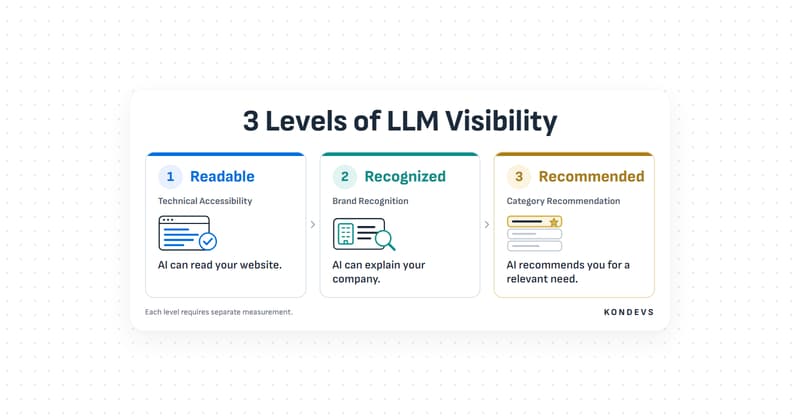
Visibilio describes AI visibility in three levels. Each builds on the one before, and each fails in its own way. We described how we apply the model in The 3 levels of LLM visibility.
1. Readable
- The question: can AI assistants and agents read your site at all?
- How to check it: public agent-readiness scanners, a markdown version of your pages, llms.txt, structured data, and robots rules that let AI crawlers in.
- How it fails: content hidden behind scripts, blocked crawlers, key facts only in PDFs or images.
2. Recognized
- The question: asked about you by name, does the assistant describe you correctly?
- How to check it: branded questions in several assistants, such as "What does [company] do?" or "Is [company] a good fit for our project?"
- How it fails: outdated services, wrong locations, an old company name, a competitor's facts mixed in.
3. Recommended
- The question: asked about the category without your name, does the assistant name you?
- How to check it: unbranded buyer questions, such as "Who can integrate SAP with our warehouse system in Germany?", and the sources the answer cites.
- How it fails: missing from the shortlist, or named for the wrong service.
The order matters. A brand that is not readable is described from second-hand sources. A brand that is readable but inconsistent is recognized wrongly, which is often worse than being absent: a buyer who meets the wrong facts first rarely checks again. Only a brand that is read and described correctly has a real chance of being recommended.
Unlike a search ranking, an AI answer is not one fixed result. It varies by assistant, by wording and by day. So measurement works like a panel survey, not a spot check:
- A fixed set of questions your buyers actually ask, half with your name and half without it, in the languages they use. For a Bulgarian company selling into the DACH region that means Bulgarian, English and German.
- Several assistants (ChatGPT, Perplexity, Gemini, Copilot), each question asked more than once, because single answers vary.
- Four things to record per question: are you mentioned, is what is said correct, is your own site cited, and which competitors appear instead.
- A schedule: the same set repeated every week or month, so you see a trend rather than a snapshot.
This is what Visibilio's AI Visibility measurement does: it runs a fixed set of topics and questions against AI assistants on a weekly to monthly cadence, repeats each question, and compares you with a list of competitors. Whatever the tool, the rule is the same: measure before you optimize, and keep the question set stable long enough to compare.
Disclosure: KONDEVS works with Visibilio, and this article was prepared with it.
We started at the first level, because everything else depends on it. On 17 October 2026 kondevs.com scored 100/100 in Is Agentic and 93 (Level 5) in Is It Agent Ready. Four public tools that test agent readiness explains what each scanner checks and what its score does not measure, and AI agent readiness and LLM visibility shows the work behind it, from llms.txt to an MCP server. For the second and third levels we track a fixed set of buyer questions; how AI assistants find, read and cite a company describes what we look at.
The lesson so far: being readable was an engineering task we could finish in weeks. Being recognized and recommended is continuous work, because the answers change whenever the assistants, their sources or your competitors do.
- Write down 20 questions your buyers ask: 10 with your company name and 10 without it.
- Ask each one in ChatGPT, Perplexity and Gemini, twice, and note whether you are mentioned, whether the answer is correct, which sources it cites and which competitors appear.
- Run your site through the public agent-readiness scanners and fix what stops assistants from reading it.
- Correct the three most damaging wrong facts at their source: your own pages first, then the profiles and directories the answers cite.
- Ask the same questions again next month and compare.
Capital's headline will age; the shift behind it will not. Your buyers will keep asking an assistant first. Make sure it can read you, describe you correctly, and has a reason to name you.