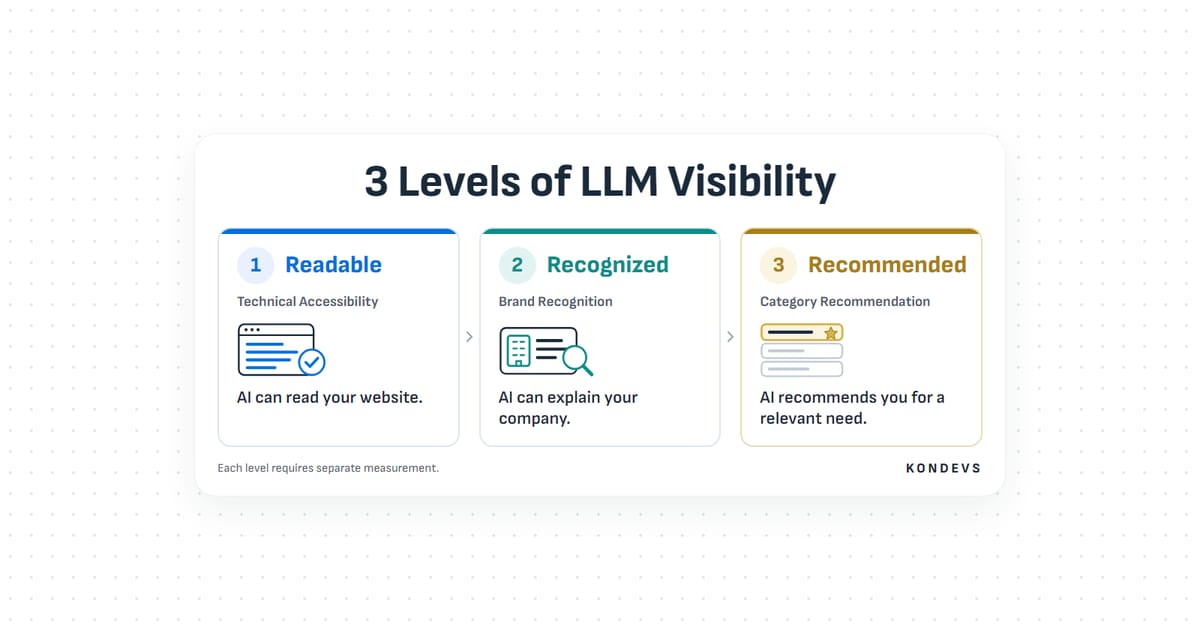
Suppose a company runs its website through a public agent-readiness scanner and gets a high score. The technical checklist looks good. But the score doesn't answer the questions that actually matter: does an AI assistant know what this company does? Would it recommend the company to someone describing a relevant need? A readiness score measures technical preconditions, not what an assistant says about the company.
A website an AI can read is a starting point. The business goal is to become a company it can accurately explain and recommend for relevant needs.
This article describes a practical framework KONDEVS uses to think about and measure LLM visibility at three levels. It is not an official standard and not a generally accepted classification. It is a working model, useful for separating what to measure and who owns each part.
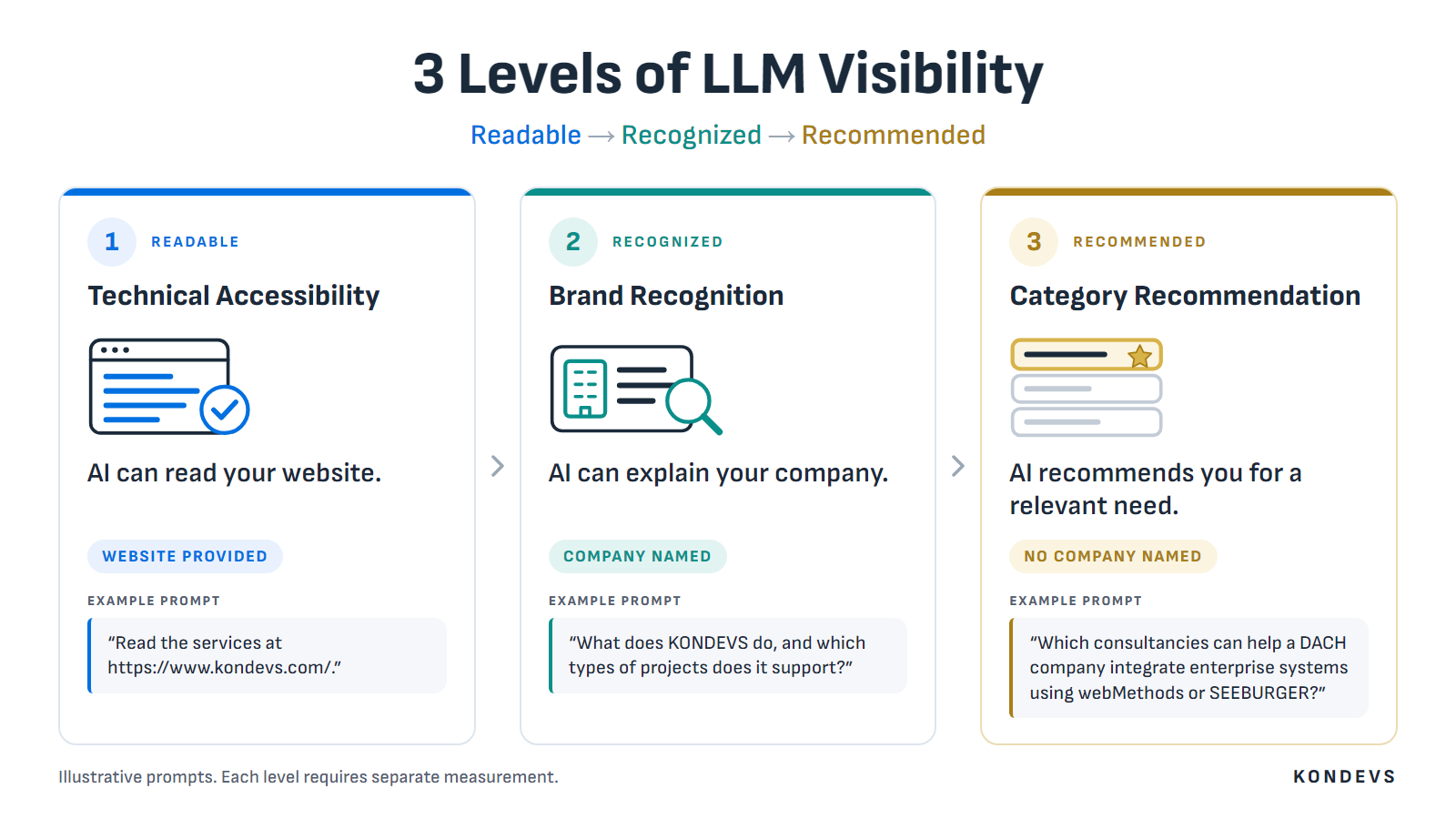
| Level | Example question | Successful result | How to measure |
|---|---|---|---|
| Level 1: Readable | "Read the services at https://www.kondevs.com/." | The assistant extracts the services from the site correctly. | Share of selected key pages an assistant can read and whose facts it extracts correctly. |
| Level 2: Recognized | "What does KONDEVS do, and which types of projects does it support?" | An accurate description of the company, its services and its relevant experience, supported by verifiable sources when the assistant uses sources. | Accuracy against a predefined list of facts; record wrong services, outdated information and confusion with other companies. |
| Level 3: Recommended | "Which consultancies can help a DACH company integrate enterprise systems using webMethods or SEEBURGER?" | KONDEVS is suggested as a suitable option, with an explanation tied to the need. | Recommendation rate: answers that recommend the company divided by all recorded answers to the selected relevant unbranded questions. Recommendation, plain mention and citation are counted apart. |
Question: Can AI access and read our website?
Example prompt: "Read the services at https://www.kondevs.com/."
What success looks like: the assistant extracts the services from the site correctly. Not a summary of what it already "knows," but facts pulled from the page itself.
What matters here is ordinary good web practice: readable HTML with the text in the page (not only built by JavaScript in the browser), clear headings, navigation that links every important page, and crawler rules (robots.txt) that don't block the assistants you want. Google's documentation on AI features is direct: there are no additional technical requirements to appear in AI Overviews or AI Mode, and you don't need new machine-readable files, AI text files or markup. A page must be indexed and eligible to be shown in Google Search with a snippet.
Some systems can also use additional formats. Markdown versions of pages, llms.txt (a proposal, not a standard) and API interfaces can help the systems that use them. MCP (Model Context Protocol, a way for AI assistants to call a service's tools) is not required for every corporate website. These are optional additions, not universal requirements. If you want the technical side, we describe how we made kondevs.com usable by AI agents.
How to measure: select key pages. Ask an assistant to read each one and extract specific facts. Record the share where the assistant reaches the content and extracts the facts correctly.
Question: Can AI accurately explain our company when asked by name?
Example prompt: "What does KONDEVS do, and which types of projects does it support?" Do not provide the URL. The test is whether the assistant already knows the company, or finds it on its own.
What success looks like: an accurate description of the company, its services (Enterprise Integration & BPM, Data Science & AI Consulting, AI Agent Development) and its relevant experience. When the assistant cites sources, those sources should be verifiable.
What matters: clear positioning, the same company facts everywhere (website, LinkedIn, directories, partner profiles), clear service descriptions and case studies. When sources contradict each other, the assistant has to choose, and it may choose the outdated version. A company that only works on its own site may still be described inaccurately because its external profiles tell a different story.
How to measure: define a list of facts a correct answer should contain (services, geography, technology platforms such as IBM webMethods (formerly Software AG) or SEEBURGER). Score each answer against the list. Record wrong services, outdated information and confusion with other companies.
Question: Does AI include our company when someone describes a relevant need?
Example prompt: "Which consultancies can help a DACH company integrate enterprise systems using webMethods or SEEBURGER?" The prompt must not contain KONDEVS, the domain or any hint to include the company.
What success looks like: KONDEVS is suggested as a suitable option, with an explanation tied to the need. This is the hardest level to reach, and no change guarantees a recommendation. Models differ, answers vary between runs, and the same question asked a week later may produce a different list.
What matters: relevant services, proven experience, concrete case studies and credible independent sources. Independent sources, such as articles, directory profiles and references that name you, can support a comparison and make it more credible. They help, but no single source is a condition for being recommended.
How to measure: the recommendation rate, defined as the answers that recommend the company divided by all recorded answers to the selected relevant unbranded questions. Distinguish three outcomes: a recommendation (suggested as a suitable option), a plain mention (named, but not recommended) and a citation (the answer links your website as a source). These are different signals; report them separately.
An illustrative example, not a recorded test: if 6 of 30 recorded answers to the selected unbranded questions recommend the company, the recommendation rate is 20%. The number holds only for that question set, those assistants and that period. Count plain mentions and citations the same way, as separate rates.
- Choose key pages for Level 1, branded questions for Level 2, and unbranded questions that potential clients would ask for Level 3.
- Use new conversations without earlier context for every test.
- Record the assistant, the model, the date, the language, and whether web search was on or off.
- Repeat the questions over time. Keep the full answers and their sources.
- Report the three levels separately. A high Level 1 result does not imply Level 2 or Level 3.
Keep the three results apart rather than combining them into one weighted score. A single number would hide which level needs work: a site can be fully readable and still rarely recommended.
Two caveats are worth stating plainly. The levels are not a required sequence: an AI assistant can know about a company from external sources even if it has never read the company's website. And one good answer does not prove lasting visibility. Answers vary between runs, models and dates, so a single test is a snapshot, not a trend. Our own method for asking buyer questions over time is described in LLM visibility: how AI assistants find, read and cite a company.
Which level has your company reached, and what would be the next useful step? KONDEVS can help you set up the questions and the measurement. Start a conversation with us.