If an AI agent researching suppliers on behalf of a buyer can't read your website, it describes your company from whatever second-hand sources it finds, or skips you entirely. That's the business risk, and it is not a theoretical one. In 6sense's 2025 Buyer Experience Report, 94% of B2B buyers used LLMs to summarise reviews or analyse data, and 94% of buying groups ranked their preferred vendors before first contacting a seller. Buyers then purchased from that preliminary favourite 77% of the time.
If the decision is shaped before anyone picks up the phone, the question becomes: can an agent find your site, parse it without JavaScript rendering, and extract the facts that matter (services, locations, contacts, how to engage)? If not, your brand is shaped by guesses. Four public tools now test exactly that. None of them agrees on a single standard. Use all four, understand what each one checks, and fix only what is real.
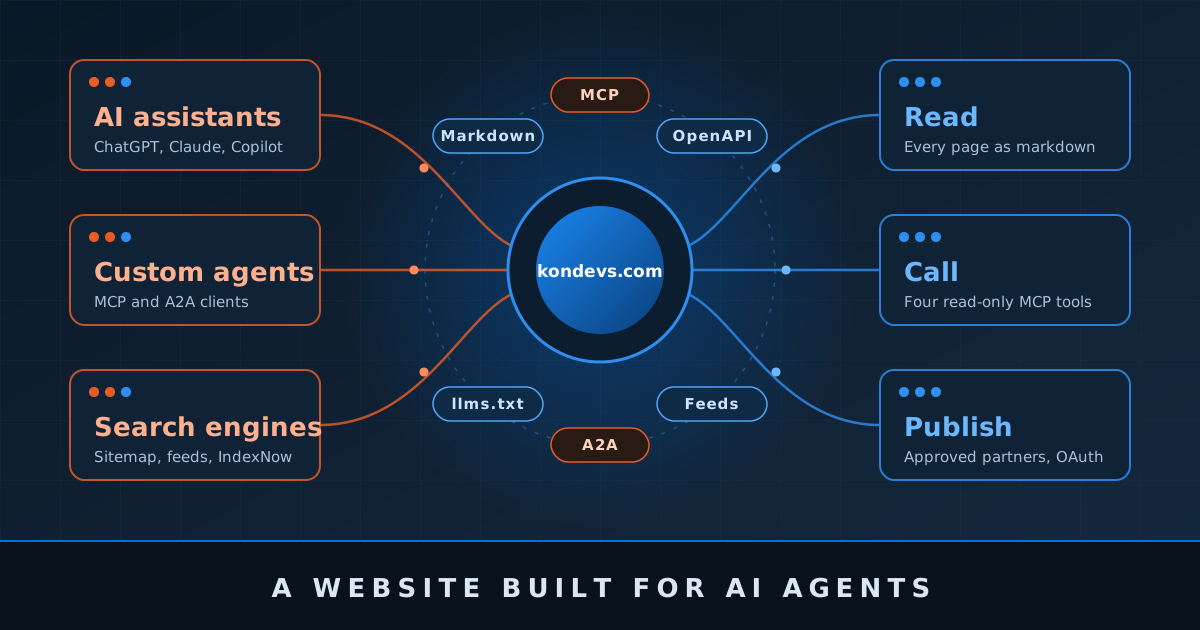
Is It Agent Ready checks the discovery documents an agent looks for when it arrives at a domain: robots.txt and the sitemap, Link headers, an API catalogue (RFC 9727), OAuth metadata, an MCP server card, an A2A agent card, agent skills, WebMCP and an ARD catalogue, plus markdown content negotiation and AI bot rules. It reports a level up to Level 5.
Why does this matter? These are the protocol-level signals that tell an agent what your site offers and how to interact with it programmatically. Without them, the agent falls back to scraping HTML, which is brittle and incomplete. One detail worth noting: the DNS-based agent discovery check requires DNSSEC at the domain registrar, so that's a task for whoever manages your DNS, not the web team alone.
First step: run the scan, check whether your robots.txt and sitemap are present and correct, and confirm DNSSEC is enabled at your registrar.
Is Agentic asks a more fundamental question: can agent user agents reach the site at all? It checks whether content is readable without JavaScript, whether llms.txt exists, whether auth.md is present, and whether pages fit within an agent's context budget (the amount of text an LLM can process in a single pass).
This is where many corporate sites fail silently. A JavaScript-heavy single-page application that renders beautifully in a browser may return nothing useful to an agent that doesn't execute client-side code. Context budget is another blind spot: a page stuffed with navigation chrome, cookie banners and boilerplate may exceed what an agent can ingest, so the actual content gets truncated or discarded.
First step: check whether your key pages return meaningful content when JavaScript is disabled, and review page weight against the context-budget check.
Mintlify Score is built on the open-source AFDocs checks. It evaluates the quality and coverage of llms.txt, whether markdown versions of pages are available at .md URLs, directives that point agents to llms.txt, page size, and parity between the HTML and the markdown version of a page.
Parity matters because an agent that gets a markdown version missing half the content of the HTML original will produce incomplete or misleading summaries of your company. Cloudflare reported that markdown content negotiation passes on only 3.9% of the sites in its scanned dataset. The bar is low, which means acting on this now creates a measurable difference.
One caveat: SE Ranking studied roughly 300,000 domains and found no measurable relationship between having an llms.txt file and how often a domain is cited in AI answers. So treat llms.txt as a hygiene signal for discoverability, not a citation guarantee.
First step: check whether your site has llms.txt and .md URLs, and compare the markdown output against the HTML for your most important pages.
Ora runs 132 checks in nine goals, covering discovery, trust, integration, authentication and payments. What sets it apart is scope: many checks concern listings outside the website, such as MCP registries and knowledge graphs. Part of the score is a business and listing task, not a website change. Ora also offers Journey, a separate product that points a real agent at a domain with an intent you choose and records every step.
That distinction matters, because a checklist alone can be gamed. A site can declare an MCP server card that points to nothing, and a static scanner will pass it. An agent that actually tries the flow will expose the failure. Which brings us to the most important point in this entire article.
First step: run the Ora scan and separate the results into website fixes (web team) and listing or registry tasks (business or marketing team).
| Tool | What it checks | What it does not check | Who acts on the result |
|---|---|---|---|
| Is It Agent Ready | Discovery documents, protocol signals, DNS-based discovery, markdown negotiation, AI bot rules | Off-site listings, content quality, agent behaviour | Web team, DNS admin |
| Is Agentic | Agent reachability, JS-free readability, llms.txt, auth.md, context budget | API catalogues, protocol-level discovery, off-site signals | Web team |
| Mintlify Score | llms.txt quality, .md URLs, directives, page size, HTML/markdown parity | Protocol discovery, authentication, off-site listings | Web team, content team |
| Ora | 132 checks in nine goals, including off-site listings and registries | Deep protocol-level discovery signals (covered by Is It Agent Ready) | Web team and business/marketing |
For the business: the company is found and described correctly when an agent does the research. The facts that matter (services, locations, contacts, how to engage) come from your own site instead of guesses. Partners and their agents can use your documented interfaces without a meeting first. And you get a measurable baseline instead of an opinion.
For the brand: control over how AI assistants describe you. Consistent facts across every channel an agent reads. Credibility with technical buyers who check these signals. And honesty, because an agent sent into a broken flow remembers the brand as unreliable.
These scores measure the technical preconditions for being found and understood by AI. They do not measure whether AI assistants actually cite the company. A study by The B2B Answer of German-language industrial queries found that AI answers draw on standards bodies, associations and company websites. Whether your site becomes one of those sources depends on more than passing a readiness scan. Measure citation separately, with a fixed set of buyer questions asked to AI assistants over time.
Declare only what you actually run. The scanners mostly read declarations without calling the service, so a fake declaration can raise a score while it sends real agents into failing flows and damages trust. If you declare an MCP server card, make sure the server responds. If you publish llms.txt, make sure the content behind it is current.
On 17 October 2026, kondevs.com went from 82 to 98 in Mintlify Score and from 90 to 93 in Ora, scored 100/100 in Is Agentic and 93 (Level 5) in Is It Agent Ready. The full details are in the KONDEVS agent readiness case study.
The first step this week: run all four scanners against your domain. Read how each check works. Fix what is real, ignore what is cosmetic, and never declare a capability you don't actually serve. The scores are a diagnostic, not a destination. What matters is whether an agent that arrives at your site leaves with the right facts.