A CTO once asked us to "just rip out webMethods and replace it with something open-source to kill the licence bill." Reasonable instinct: that bill was eye-watering. Six weeks later we'd mapped what the platform was actually doing: 200-plus EDI partner connections, file transfers his bank's regulators audited, and monitoring three teams quietly depended on. The open-source "saving" had turned into a two-year rebuild.
The lesson wasn't "commercial always wins." It was that "commercial or open-source?" is the wrong question until you know exactly what you're integrating, for whom, and at what cost of failure. After fifteen years building on webMethods (and evaluating open-source alternatives for clients across European finance, rail, and insurance) here's the pragmatic version, minus the vendor pitch and the open-source evangelism.
IBM webMethods: what you're really buying
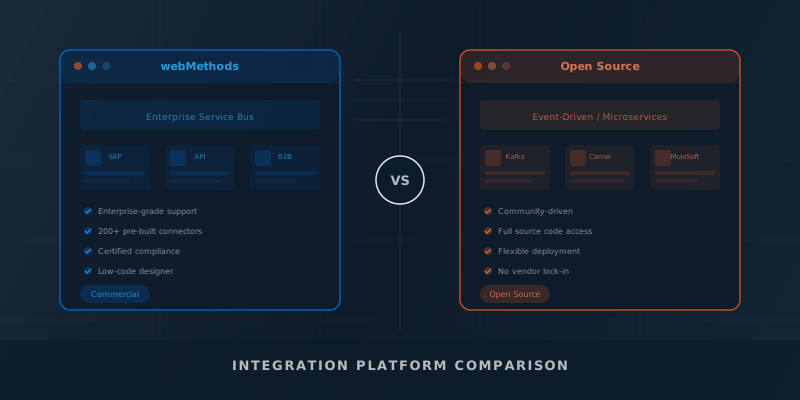
#webMethods is a mature, enterprise-grade suite: ESB, API management, B2B/EDI, managed file transfer, and IoT connectivity in one coherent product.
Where it earns its licence:
- One platform, not seven. ESB, API gateway, B2B/EDI, MFT, and IoT under one roof, one support contract, one upgrade path: instead of integrating your integration tools.
- Support that picks up the phone. 24/7 vendor SLAs and predictable patching: the kind of thing that matters at 3 a.m. when a payment run is stuck.
- Proven where failure is expensive. It runs in production at major banks, railways, and health-insurance systems moving millions of transactions a day. We've built on it at exactly that tier: Deutsche Bank, ÖBB, and middleware linking 80+ statutory health funds.
- Mature tooling. Monitoring, dashboards, and admin consoles you don't have to assemble yourself.
What you pay for it, and not only in cash:
- Licensing scales with cores, connectors, and volume. At enterprise scale it becomes a board-level line item, not an IT one.
- Lock-in is real. The deeper you build into proprietary components, the costlier the eventual exit.
- The talent pool is specialist and smaller than for mainstream stacks. Plan your hiring and your bus factor around it.
Open-source alternatives: what you actually get
#The open-source landscape has matured into genuinely production-grade options. Apache Camel (the Swiss-army knife of integration patterns), WSO2 Micro Integrator, Apache Kafka Connect, and Apache NiFi each cover a wide range of real workloads.
Where it shines:
- No licence meter. The software is free; you pay for infrastructure, engineering, and whatever support you choose to buy.
- Ecosystem and source access. Large communities, hundreds of connectors, and the ability to read, patch, and extend the code yourself instead of filing a ticket and waiting.
- Cloud-native by design. Most are built for containers and Kubernetes from the ground up: an advantage if that's the direction you're heading.
What the "free" label hides:
- You own support, or you buy commercial support that may not match a vendor's SLA.
- Coverage gaps. Core ESB and routing are strong, but B2B/EDI, MFT, and turnkey monitoring usually mean bolting on extra tools.
- Operational overhead. The deployment, monitoring, and governance stack that ships boxed with webMethods, you assemble and maintain yourself.
The honest answer: it's rarely either/or
#The strongest landscapes we see are hybrids. Commercial platforms carry the mission-critical, high-volume, audited flows: the ones where a vendor SLA is simply cheaper than the risk. Open-source handles departmental integration, development and test environments, and newer cloud-native workloads where flexibility and cost matter more than a support contract. The skill is drawing that line in the right place, and revisiting it as the business changes.
Four questions that actually settle it
#- Volume and SLAs. Are these flows mission-critical and high-volume? That's where commercial platforms tend to pay for themselves.
- Existing investment. Already running webMethods with a team that knows it? The migration bill rarely beats the licence bill.
- Cloud strategy. Going cloud-native? Evaluate cloud-native integration on its own merits: the architecture matters more than the commercial-vs-open-source axis.
- Team capability. Be honest about whether your team can run an open-source platform in production at 3 a.m., not just stand one up in a demo.
Where KONDEVS stands
#We have deep webMethods expertise and no ideological stake in the answer. We've migrated flows off commercial platforms where it saved real money, and we've talked clients out of migrations that would have cost more than they saved. The right choice is the one that fits your transaction volume, your team, and your roadmap, not the vendor's quarter or the loudest opinion online. If that's the decision in front of you, let's talk.