
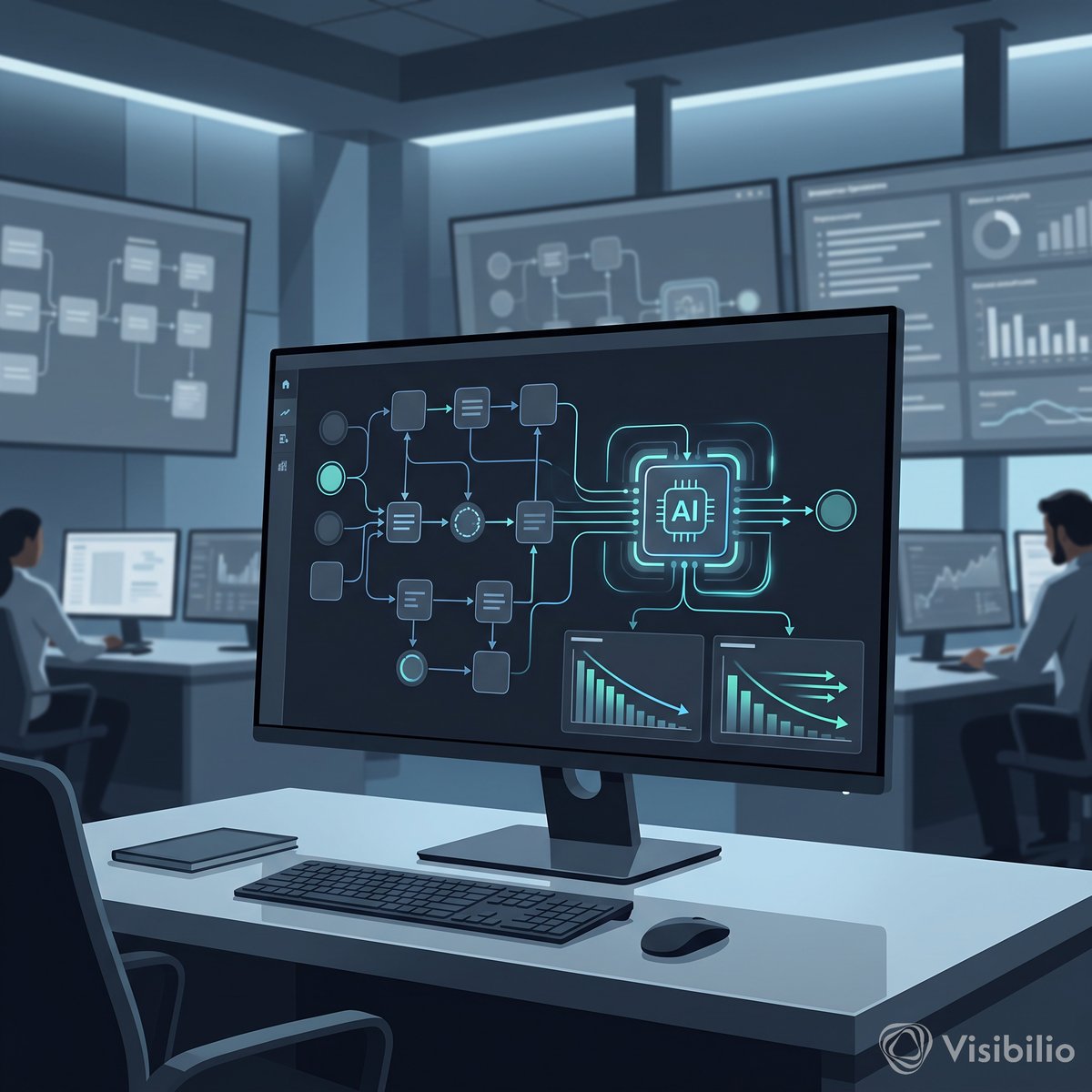
Anthropic released Claude Opus 5.5 on September 22, 2026, with two numbers that matter to anyone running AI steps inside enterprise processes: $4 per million input tokens and $20 per million output tokens. That's a 20% drop on both input and output compared to Opus 5, according to reporting from VentureBeat and DataCamp. Anthropic also claims the model generates output more than 30% faster and cuts typical workload costs by roughly 40%. For BPM leads who've been watching token economics eat into automation budgets, those figures change the unit cost math for every AI-augmented workflow step.
But cheaper and faster doesn't answer the question that actually determines whether Opus 5.5 belongs in your process flows.
Opus 5.5 Is a Component, Not an Orchestration Engine
Coverage positions Opus 5.5 as optimized for longer-running, multi-step "agentic" tasks: coding, research, computer use, professional knowledge work. It introduces what Anthropic calls "always-on adaptive thinking" with an effort setting that controls reasoning depth. The model also aims for more direct communication, leading with key information and cutting unnecessary jargon.
None of it replaces what a BPM engine does. Opus 5.5 doesn't manage durable state. It doesn't handle deterministic routing, timers, retries, or human-task queues. It doesn't produce audit trails. Wire it into a process without a proper orchestration layer underneath, and you lose traceability, accountability, and the ability to prove what happened after the fact.
The defensible pattern: keep orchestration deterministic in your BPM layer (Camunda, webMethods, or whatever runs your process estate), and call Opus 5.5 for bounded cognitive tasks. Classification of unstructured inputs. Summarization. Exception triage. Drafting documents a human then reviews. The model handles interpretation; the engine handles control.
Five Steps Before You Wire It Into a Workflow
The temptation is to start with the model. The discipline is to start with the process. BPM best-practice guidance is blunt: don't automate a process just because it exists. Map how work actually happens, improve it, then automate. Otherwise you accelerate waste.
First, establish baseline metrics before you touch anything: cycle time, rework rate, SLA compliance, cost per transaction. Without a baseline, you can't prove ROI and you can't isolate Opus 5.5's contribution from other changes. Second, identify which process steps are genuinely unstructured and high-leverage enough to justify an AI call. Email intake parsing, document understanding, exception explanation: candidates. Approval routing, timer-based escalation, compliance checkpoints: stay deterministic.
Third, design the governance layer. If Opus 5.5 is drafting customer-facing or compliance-relevant content, you need human review gates, permissions, and audit trails in the orchestration flow. Fourth, model the token economics. At $4/$20 per million tokens, a high-volume invoice-processing workflow with thousands of daily AI calls has a calculable operating cost. Run the numbers before the pilot. Fifth, plan for model behavior drift. Opus 5.5 behaves a certain way today. Models change. Your architecture needs to detect when output quality degrades and route to a fallback: a simpler model, a rule-based path, or a human queue.
Governance as Architecture, Not Afterthought
The EU AI Act's transparency and oversight requirements, applicable from August 2, 2026, add regulatory weight to what should already be architectural common sense. When an AI model influences a decision inside a business process, someone needs to explain what happened, why, and who approved it. That explanation can't live inside the model. It lives in the orchestration layer: the process log, the decision audit trail, the exception record.
Opus 5.5 can triage an exception brilliantly. The BPM layer records that the exception was triaged, by which model version, with what confidence score, and whether a human reviewed the output before it moved downstream. Without that separation, you're building speed on top of an accountability gap.
The Attribution Problem
Secondary sources cite impressive BPM automation outcomes: invoice processing reduced from twelve days to under three, document-error reductions up to 80%, audit-preparation time cut by 40–50%. Those numbers come from broader BPM implementations reported by Moxo and others. They aren't Opus 5.5 results. Treating them as expected outcomes for an Opus 5.5 deployment would be exactly the attribution error that erodes trust in AI projects. Measurement guidance from Kissflow reinforces the point: be cautious about attribution when other initiatives may influence outcomes. The only honest answer requires the baseline you captured before you started and a design that lets you isolate variables.
Where This Leaves Enterprise Teams in Late 2026
Opus 5.5's price and performance improvements are real. For integration architects working across webMethods, Camunda, SEEBURGER, or mixed estates in DACH and broader European enterprises, the model lowers the cost barrier for embedding AI into process steps that previously didn't justify it. The adaptive thinking feature and clearer output style make it a stronger candidate for business-facing workflow tasks than its predecessor.
But the model is one actor in a cast that includes APIs, BPM flows, approval steps, legacy services, and audit requirements. The architecture around it determines whether it creates value or creates risk. Before you celebrate the token price drop, design the control. Define the fallback. Capture the baseline. If a model can route, it can misroute, and the process log, not the model, is where you'll find the evidence.