
SAP-centric enterprises don’t fail at RAG because the model is “not smart enough.” They fail because retrieval is unreliable under real constraints: auditability, latency budgets, data classification, and runbooks that differ by one version number. In that environment, vector search alone is a precision risk, not just a quality issue.
The problem shows up in the smallest details. Dense embeddings are good at semantic similarity, but they’re weak at discriminating exact entities like error codes, policy IDs, and version strings—exactly the tokens that operations teams treat as non-negotiable. Aaditya Chauhan’s InfoQ piece on hybrid retrieval for RAG frames it plainly: production queries are often hybrid, and single-method retrieval (vector-only or BM25-only) doesn’t cover that mix (InfoQ).
And the data backs up the intuition. In Microsoft testing cited by Redis, average relevance scores were reported as 48.4 for hybrid retrieval versus 43.8 for vector-only and 40.6 for keyword-only (Research Brief, source [2]). That gap is not academic. It’s the difference between a grounded answer and an incident ticket.
Why this matters now: RAG is becoming infrastructure
In 2026, the shift is from demo RAG to production RAG. That means governance and operability move from “later” to “day one.” The retrieval layer becomes part of the integration layer: it decides what the model is allowed to see, what it cites, and what it ignores. If that layer is noisy or inconsistent, the generator can’t compensate—no matter how strong the LLM is.
There’s also a cost dimension that tends to be underestimated. Better retrieval precision reduces how much irrelevant context gets stuffed into prompts. Redis notes that improved retrieval can reduce downstream LLM token costs by tens of percent, depending on corpus and query patterns (Research Brief, source [2]). In enterprise MLOps terms, retrieval quality is a cost-control mechanism, not just a relevance tweak.
What breaks with vector-only retrieval in enterprise ops
Vector retrieval clusters “similar meaning.” That’s useful when the user asks conceptual questions. It’s dangerous when the user asks for an exact procedure tied to a specific identifier. Chauhan gives the operationally realistic failure mode: two runbooks that are semantically similar (enable vs disable, rollback vs roll-forward) can land near each other in embedding space, and the wrong one can be retrieved (InfoQ). In regulated environments, that’s not a minor mistake. It’s an audit finding waiting to happen.
Keyword search (typically BM25) has the opposite shape. It’s excellent when the query contains the literal token that matters: an error code, a policy clause number, a deployment version. But lexical retrieval is brittle when teams use different phrasing across departments, or when the “right” document doesn’t share enough surface terms with the question.
So the enterprise reality is three query types—semantic, exact-match, and hybrid—and the third one dominates real workflows. Meilisearch describes hybrid search as combining exact word matches with vector search so the system can capture both literal terms and semantic intent (Research Brief, source [6]). Glean’s enterprise-oriented argument is even more direct: vector search alone is insufficient for complex enterprise retrieval; hybrid approaches plus additional signals produce better results (Research Brief, source [7]).
The pragmatic pattern: parallel retrievers + fusion + reranking
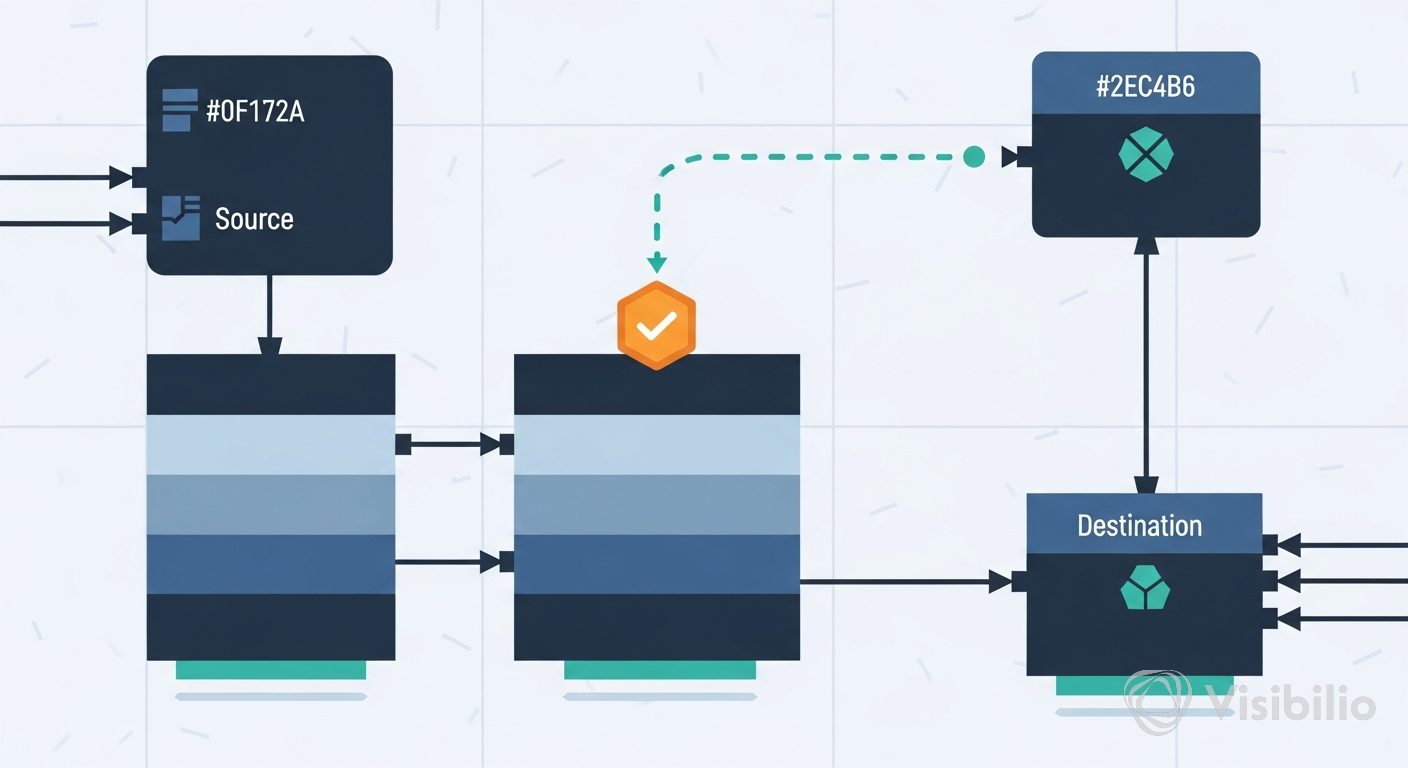
Here’s the pattern that holds up in production: index the same content twice (a BM25/keyword index and a vector index), retrieve in parallel, then fuse and rerank. This shows up repeatedly in the Research Brief as a common implementation approach: parallel sparse + dense retrieval followed by fusion/reranking (Research Brief, sources [1][5]).
Chauhan’s article focuses on one fusion method that fits enterprise constraints: Reciprocal Rank Fusion (RRF). Instead of trying to normalize scores across BM25 and vector similarity (which is messy and model-dependent), RRF combines results based on rank position. Documents that both methods rank highly get rewarded; one-off hits sink (InfoQ).
Weighted hybrids are also common—an illustrative mix in the Research Brief is 70% dense / 30% sparse (Research Brief, sources [1][5]). Treat that as a starting point, not a rule. The better approach—actually, the only defensible approach—is to tune weights and fusion parameters against your own query distribution with an evaluation loop.
Then comes the second stage that separates “it works in a notebook” from “it survives production”: reranking. The Research Brief calls out second-stage reranking (often with cross-encoders) as a best-practice step to improve relevance before generation (Research Brief, sources [2][3]). This is where you spend compute to buy back precision—after you’ve narrowed candidates cheaply via BM25 and kNN.
Security, governance, and MLOps: make retrieval a controlled subsystem
Hybrid retrieval increases moving parts. Two indexes, a fusion strategy, a reranker, and usually an orchestration/routing layer that decides how to retrieve and how to merge results (Research Brief, source [1]). That complexity is acceptable only if it comes with guardrails.
Start with concrete artifacts that security and operations can inspect: an index mapping spec (text fields for BM25 plus dense vector fields), an interface contract for the retriever API, and a data-classification policy that determines what content is eligible for retrieval. In practice, this means enforcing access control at query time and at index time, and preserving traceability: which chunks were retrieved, from which source documents, under which identity, with which filters.
Metadata is not optional. The Research Brief highlights metadata enrichment—timestamps, authors, document type, department, process stage—as a lever for precision (Research Brief, sources [1][2]). In enterprise integration terms, that metadata is the join key between content and process context. Without it, retrieval can’t respect workflow state (draft vs approved), retention rules, or “only show policies valid for region X.”
Finally, treat evaluation as ongoing operations, not a launch checklist. Build an SLI/SLO set around retrieval and generation: top-K hit rate for known queries, citation coverage (answers backed by retrieved sources), latency percentiles for retrieval and reranking, and cost per query (including token spend). Add a runbook and an error taxonomy: missing access filters, stale indexes, chunking regressions, reranker timeouts, and “silent drift” where relevance degrades after content changes.
Vector search is still a core tool. It just isn’t a sufficient system. Hybrid retrieval—BM25 plus embeddings, fused with something like RRF, then reranked under governance—fits the enterprise constraint that matters most: reliability under change. When retrieval becomes a controlled subsystem with observability and security boundaries, RAG stops being a clever demo and starts behaving like production infrastructure.