Every operations leader knows the process that looks fine on the dashboard and falls apart in practice. The claim that sat untouched for six days because no rule flagged it. The "urgent" case routed to whoever was next in the queue rather than whoever could actually resolve it. The invoice mis-keyed at 2 a.m. by a tired human.
Traditional Business Process Management (BPM) (model a workflow, run it in an engine, watch the KPIs) handles the predictable, rule-based parts of work beautifully. It struggles with everything that needs judgement, reads unstructured data, or hides in patterns no analyst has time to spot. That's the gap artificial intelligence closes.
From rules you write to patterns it learns
#Classic BPM runs on explicit rules: if a claim exceeds €10,000, route it to a senior reviewer; if a credit score drops below a threshold, trigger extra verification. Humans write those rules from their understanding of the process: which means the process can only ever be as smart as the rules someone remembered to encode.
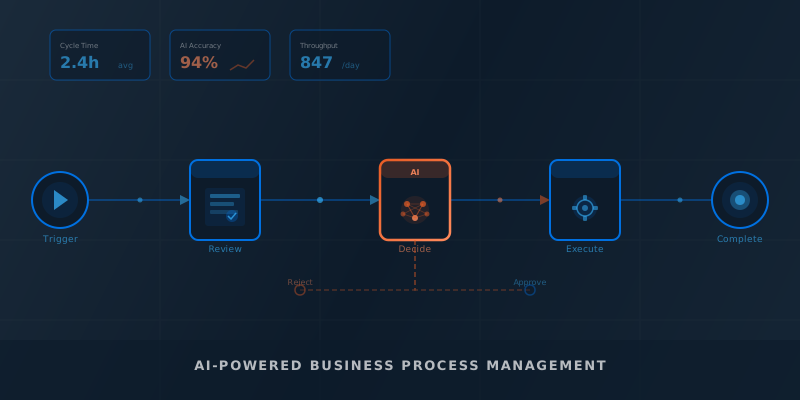
AI-enhanced BPM flips that. Instead of hand-coding every rule, machine-learning models learn patterns from the history the business already generated. They surface which cases are likely to escalate, predict how long work will take, and flag anomalies that no static rule was ever written to catch. The rules don't disappear: they get a layer of learned intelligence on top.
Four places AI earns its keep
#Process mining
Your systems already log everything they do. Process mining turns those event logs into an honest map of how a process actually runs, not the tidy diagram in the handbook. ML algorithms reveal the real variants, the rework loops, and the bottleneck that quietly adds three days to every fifth case.
Intelligent task routing
Round-robin and skill-based routing are blunt instruments. A model that weighs current workload, individual expertise, historical performance, and case complexity assigns the right work to the right person, and the measurable result is faster resolution and far less queue imbalance.
Predictive SLA management
By the time a dashboard turns red, the SLA is already breached. Models trained on historical cases predict which open cases are heading for a breach while there's still time to act: turning process management from reactive firefighting into proactive intervention.
Document classification and extraction
A huge share of business processes choke on unstructured documents: invoices, contracts, correspondence. NLP models classify each document, pull out the fields that matter, and feed clean, structured data straight into the workflow: removing the manual-keying step that is so often the slowest and most error-prone in the chain.
The part everyone underestimates: integration
#Here's what rarely makes the conference slides. None of this works without reliable data flow: process data streaming to the ML models, predictions flowing back to the BPM engine, both wired into the enterprise systems that generate and consume the work. The model is the easy 20%. The pipelines, contracts, and governance around it are the 80% that decides whether the project reaches production or dies in a notebook.
That's exactly the seam where KONDEVS works. We pair deep BPM delivery (Camunda, webMethods) with a hands-on AI practice, so the integration engineers who know where your enterprise data lives are the same team grounding the models in it. The result ships, and stays accurate once it does.
How to start without overreaching
#AI-enhanced BPM augments human judgement; it doesn't replace it. The teams that succeed don't boil the ocean: they pick one process with good historical data, a clear performance metric, and real business impact, pilot it, measure honestly, and scale only what proves out. Start narrow, prove the value, then widen. The technology rewards discipline far more than ambition.